

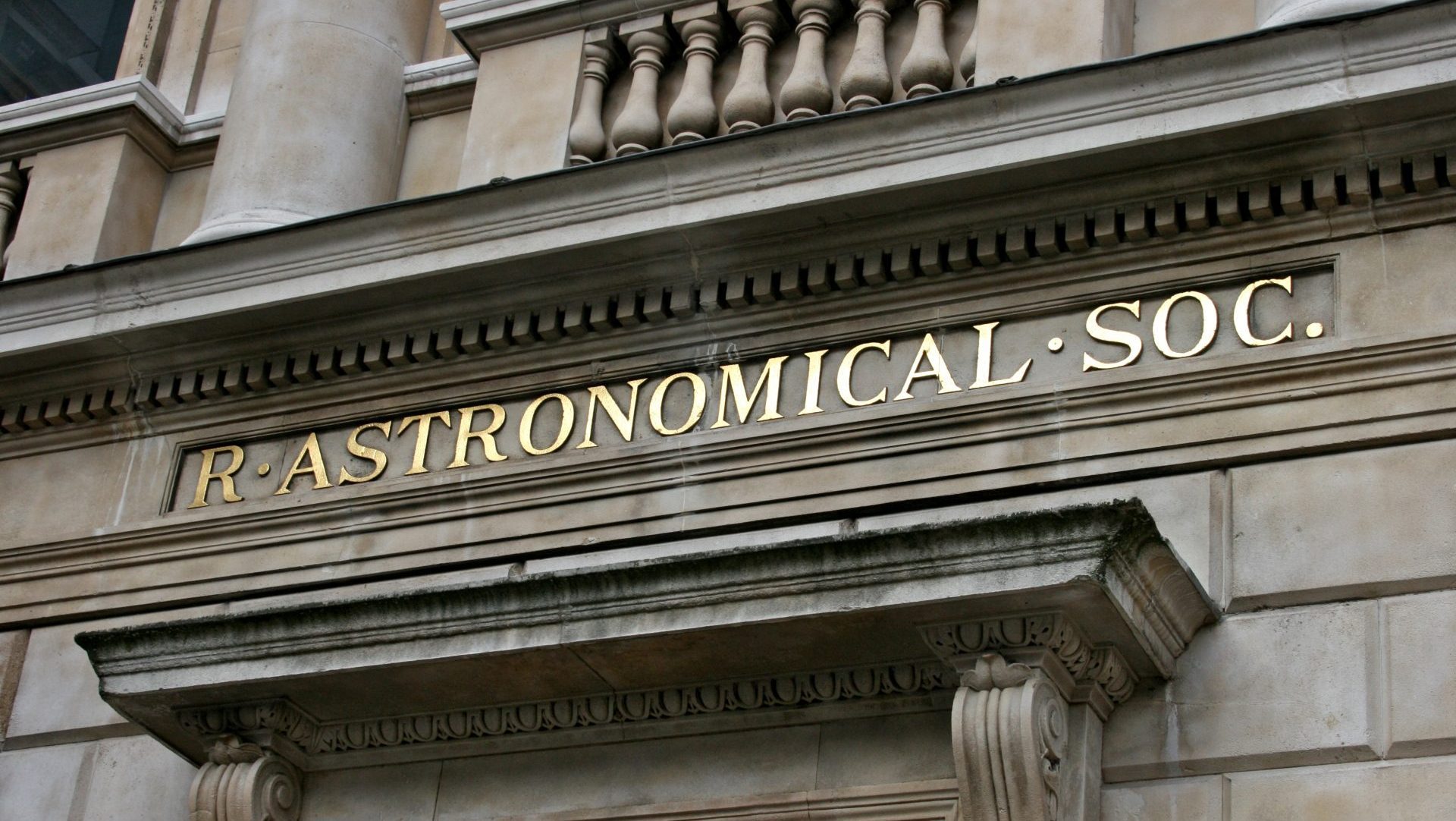
Four researchers from the University of Oxford have been honoured in the Royal Astronomical Society’s (RAS) 2026 Awards. Professor Suzanne Aigrain, Dr Deaglan Bartlett, and Professor Andrew Bunker from the Department of Physics all received awards, along with Associate Professor Paula Koelemeijer from the Department of Earth Sciences.
The ceremony recognises significant achievements in the fields of geophysics and astronomy, with some awards aimed at younger scientists in the field, while others recognise research experience. Professor Mike Lockwood, President of the RAS, extended his congratulations to the recipients for their achievement and “effort to spark interest in potential young scientists”.
Professor Aigrain was awarded the George Darwin Lectureship in recognition of her research on detecting and characterising exoplanets. She has been involved in surveys that have discovered thousands of new exoplanets over 25 years, developing research methods which are now widely used. Aigrin is also took part in the European Space Agency’s PLATO mission and the UK-led Terra Hunting Experiment.
Professor Aigrain told Cherwell: “Exoplanet research has tremendous resonance for the general public in their broader context, and aims to answer questions like ‘where do we come from’ and ‘are we alone’.”
Professor Aigrain also plays a key role in scientific outreach initiatives and is a former TEDx speaker. In a comment to Cherwell, she emphasised the need to “demystify the process of scientific research, and to inspire others” through outreach work.
Professor Bartlett was awarded the Early Career Award in Astronomy. His work focuses on developing statistical and machine learning methods, including the construction of high-performance machine learning models, for research in cosmology and astrophysics. His research involves international collaboration to apply machine learning to accelerate and improve computer simulations of the Universe.
Professor Bartlett told Cherwell: “My work focuses on a branch of machine learning where we ask the machine to discover (hopefully simple) mathematical equations.” He also described the great change to his research being brought by AI, which comes with “both risks and benefits”.
Professor Bartlett told Cherwell he was “totally delighted” to receive the reward: “It is an honour to receive such an award, and humbling to receive this recognition from the RAS.”
Associate Professor and seismologist Paula Koelemeijer from the Department of Earth Sciences was honoured with the Fowler Award for Geophysics. Koelemeijer’s work involves a range of seismological applications, including the use of seismic noise to study human and animal behaviour and global tomography to image deep Earth structure.
Professor Koelemeijer told Cherwell: “A lot of my research focuses on imaging of the Earth, to diagnose processes that occur, very similar to CT scans of a human body. This is fundamental research…fundamental science often leads to innovation and developments in applications in the end.
“The news of the award was ‘an early Christmas present’. It is a real honour to be recognised for something that I enjoy doing.” She thanked her mentors, collaborators and students, without whom “the research that led to this award would not have been possible”.
Andrew Bunker from the Department of Physics was awarded the Herschel Medal, honouring investigations of outstanding merit in observational astrophysics. His research focuses on the formation and evolution of galaxies and the search for distant galaxies formed when the Universe was far younger. He has recently worked on the near-infrared spectrograph NIRSpec on the James Wepp Space Telescope, an extremely sensitive instrument that has enabled the discovery of some of the most distant galaxies yet observed.
The Royal Astronomical Society told Cherwell: “Scientific outreach is extremely important because it helps to inspire the next generation, seeks to attract people from all backgrounds and walks of life to the wonder of astronomy and geophysics, and allows those within our fields to share their passion and excitement about their subject.”
Professor Andrew Bunker was contacted for comment.


 2026 Awards.)