

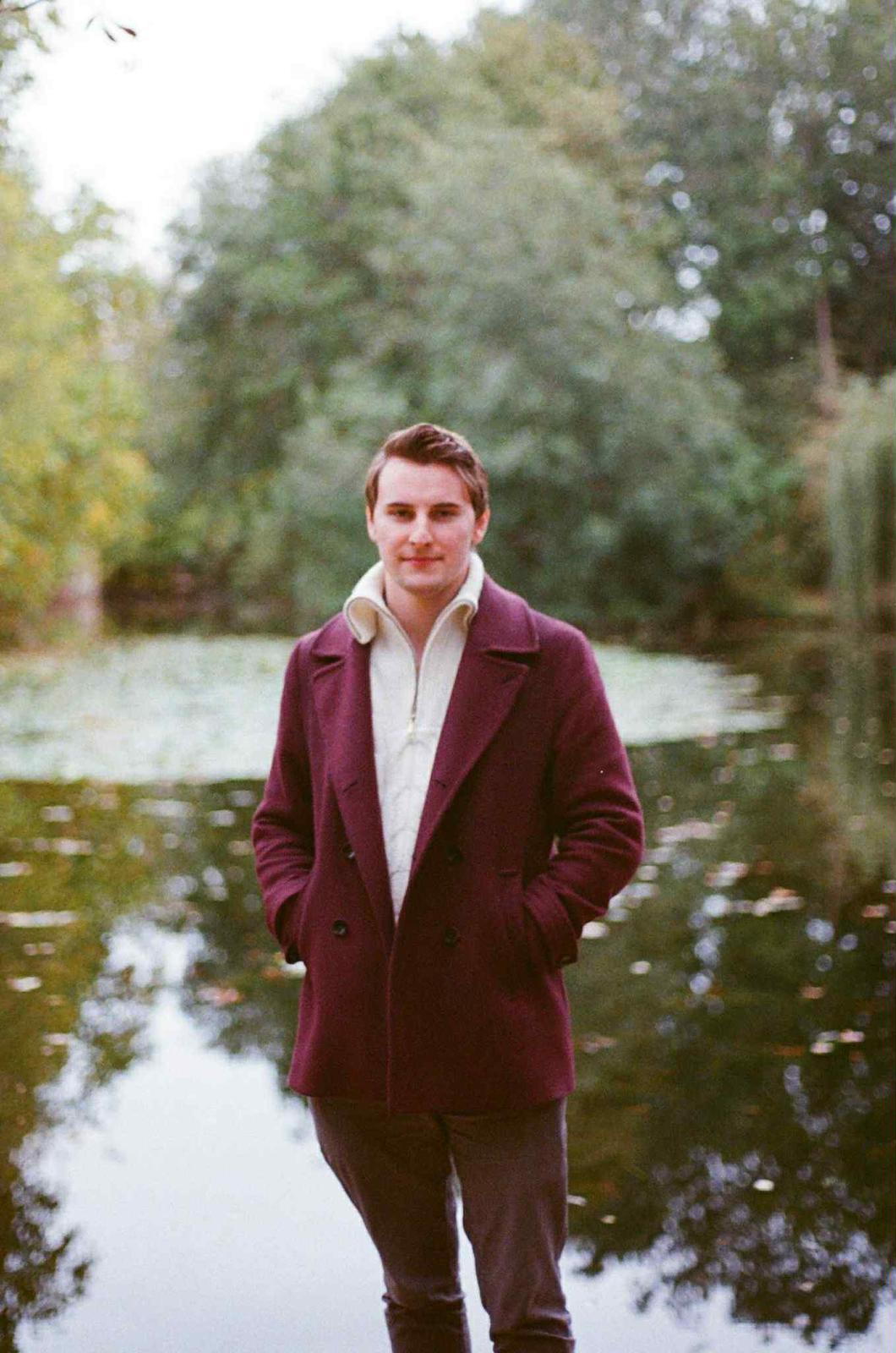
Joshua Robey is a name that has quickly been gaining traction in that very particular bubble that is the Oxford University Drama Society (OUDS), the heart of Oxford’s theatre scene. From sold-out runs to glowing Peter Kessler reviews, his first-year directorial debut was not one to be missed. A DPhil student specializing in contemporary theatre, he made the most of Oxford drama from the get-go, and, having already staged productions in the Pilch, O’Reilly and Burton Taylor Studio, he’s now left with the showstopper: the Oxford Playhouse. Yet the challenge is doubled for Joshua who has also chosen to step out of his comfort zone by taking on a musical – and none other than Stephen Sondheim’s Company. In a small room tucked away in Worcester College, I sat down with him to discuss his journey into theatre, the singularities of OUDS, and the exclusive details of his upcoming production.
Joshua’s interest in drama was one born out of his early theatre-going experience. At 17, he was struck by a number of outstanding London productions, and he cherishes a particularly vivid memory of watching The Writer, a play he directed last year: “It completely changed what I thought theatre could be. It was so alive and political and funny and exciting and that really hooked me in.” Though subsequently interested in directing, COVID entered stage in the middle of his undergraduate degree, and it was only upon returning for a Master’s at Cambridge that Joshua was able to try his hand. Interestingly though, he also wrote a “comic operetta” during that time, but when I ask if he would ever stage a play of his own, he describes himself as “a little bit allergic” to his own writing. “I only want to do a play if I really believe in it and I think it’s that act of belief that’s really hard when you’re working with your own work.” Though Joshua had long wanted to be a writer, through directing, he discovered an alternative form of creativity better suited to him: “I think some people’s brains work well with a blank page and some people’s brains work well with material that you can then play around with and reshape. I love thinking about how you can creatively add to something that exists. You have something that works as a text but then needs to be translated to a physical space and I love doing that.”
Despite his attraction to the act of iteration, Joshua has developed an approach to directing that is itself unique. He does the sound design for most of his productions and emphasises its importance in his early brainstorming: “I think it’s where I personally find a lot of feeling in a show. Even yesterday, when I was thinking quite a bit about a show I might want to do at some point in the future, all of the ideas I started with were sound. And then the next thing I was doing was thinking, what might it look like? How might it physically sit in space? It’s the order I often go in. Sometimes you just need the absence of sound: you need the spareness, but often it is that you just need a heartbeat to the play and that’s what the sound will give you.” Joshua’s recent staging of Uncle Vanya is testament to this fact, with the addition of contemporary songs played by the bard (Oli Spooner) representing one of the most unique elements of the production.
Josh’s interaction with his actors is also distinctive. Prior to the interview, I sat in on a Company rehearsal and, as I later told him, his background in English Literature became very quickly apparent. Heavily text-centred and discursive, the rehearsal reminded me of my own English classes, as each actor seemed to advocate for their own singular understanding of the musical. The investment in the text was undeniable and, in many ways, it felt like watching a debate unfold in parallel to the scene. “I definitely want rehearsals to be led by dialogue. I think it’s so important that actors are able to ask questions and explore things because if they don’t feel able to ask questions they’re just going to sit on things and then you’re going to see that but find it hard to fix. So I think it’s really important that your cast feel able and empowered to ask questions. That approach to text in rehearsals is something more typical in plays but that I brought across to Company because I think it’s really important.”
Joshua describes his transition from directing plays to a musical as, in part, a personal challenge. “I had this vision of myself, and I think other people probably did as well, as someone who wouldn’t really do a musical. So I thought, ‘Well, lean into the perversity of that. What would a musical that I direct look like?’ And I think, in some ways, I was inspired by the kind of deconstructed musical that is quite common in London at the moment. You have Oklahoma at the Young Vic in the West End; that was quite a radical unworking of some of the potential problems it creates for audiences. And then, Jamie Lloyd’s Sunset Boulevard as well is a really expressionistic take on the original show. So that sort of gave me an arrow in the right direction of where I might go with a musical.
And then I was considering what would connect with a student audience in a way that was interesting. I was drawn to Company because, when I first read and listened to it, I thought, ‘This is about someone who is at a stage of life where they need to grow up’. I thought there was something really resonant between students and someone like Bobby who’s 35, entering an early midlife crisis and feels he’s not quite grown up. At university, there’s this constant churn of people coming in and out and something about that late third year, and postgraduate experience which I’m coming at it from, involves thinking, ‘Am I ready to take that next step?’. That really felt resonant in a kind of abstract way in Company and I thought it was a feeling worth exploring.”
Keen to experiment with more “expressionistic takes on shows” this year, Joshua explains how he chose to take a non-literal approach to staging Company. He first describes the set, cryptically, as “an open arena in which there are things that are not actually in the play.” I sense his reluctance to disclose a secret that has clearly long been on his mind as he gradually reveals his creative vision: “We started with the themes of the show and the idea of play. As a result, we started thinking a lot about playground equipment and, eventually, we ended up with the aesthetic of an indoor soft play centre. Hopefully, the audience will be able to see that kind of unmoored relation between what’s happening in the real scenes and what’s happening in this abstract space where this musical is taking place. Our set designer, Holly Rust, is designing a really wonderful, really wonderful space for us on these two levels, with a slide that will hopefully be full of character while chiming very closely with the themes in our interpretation.”
Outside of realising an ambitious set design, the production company must also navigate the Playhouse’s own unique challenges. Joshua explains that, in comparison with his earlier Oxford productions, Company has required far more logistical planning. Blocking is to be communicated with Playhouse lighting designers and technicians, necessitating significant foresight, whilst designing the set involves an early review of budgeting and safety checks. For Joshua, who seeks to pursue directing beyond Oxford, this presents a learning opportunity: “It means that you need to work out what you’re doing quite early and it gives you less scope for that sort of in-the-room inspiration. It’s a very worthwhile challenge because it is more how theatre operates outside of a student context: there’s flexibility but you have to plan what you’re doing quite far in advance.” Joshua has also found Oxford’s production company model, distinct from Cambridge’s system, to have borne its fruit, and describes it providing significant financial and marketing freedom.
When discussing the more general Oxford drama scene, however, Joshua explains that he is somewhat on the fringes of OUDS. “I do OUDS shows by dint of that’s what people call it here. I don’t feel like I’m recruiting from within OUDS, I feel like I’m recruiting from within Oxford students.” OUDS, technically a society, is often under scrutiny. Whilst a real community for many, some find it to be unwittingly exclusive and, as we discuss its stereotypes, Joshua touches on the challenges of casting within such a tight-knit talent pool: “I think what is definitely true is that there could be ways of getting more people into theatre in the first place. When you’re an actor, you are reliant on whether people cast you. I’ve spoken to actors who auditioned for loads of things and got nothing. And that is tricky. There are also a lot of people who do a lot of shows. I don’t have a solution to any of this, but I think that is probably true.”
On the other hand, what Joshua finds increasingly exciting within OUDS is “a resurgence of people doing contemporary theatre and really interesting plays”. He sees plays written in the last ten years as an ideal starting point for student drama. Though many perform classics at Oxford, in part due to the barrier of copyright fees for more modern works, Joshua contends that, in many ways, you “get more out of it if you’re directing a play where you’re connected to its cultural context; you can then take that and explore it in interesting directions.”
Finally, with Company’s show run imminently approaching, I ask Joshua what the ideal outcome for a production looks like to him: “I guess it comes from audience experience. I think that’s maybe what I’m looking for. I think the measure of success of a show is based on whether the audience felt or thought in interesting ways – and I think, I maybe lean towards the feeling more than the thinking. It doesn’t have to be prescriptive, it doesn’t mean they all need to feel the same thing. But they do need to feel something. I think that’s so important.”
Company, by Fennec Fox Productions, is running from the 28th-31st January 2026 at The Oxford Playhouse


, the heart of Oxford’s theatre scene. From sold-out runs to glowing Peter Kessler reviews, his first-year directorial debut was not one to be missed.)