

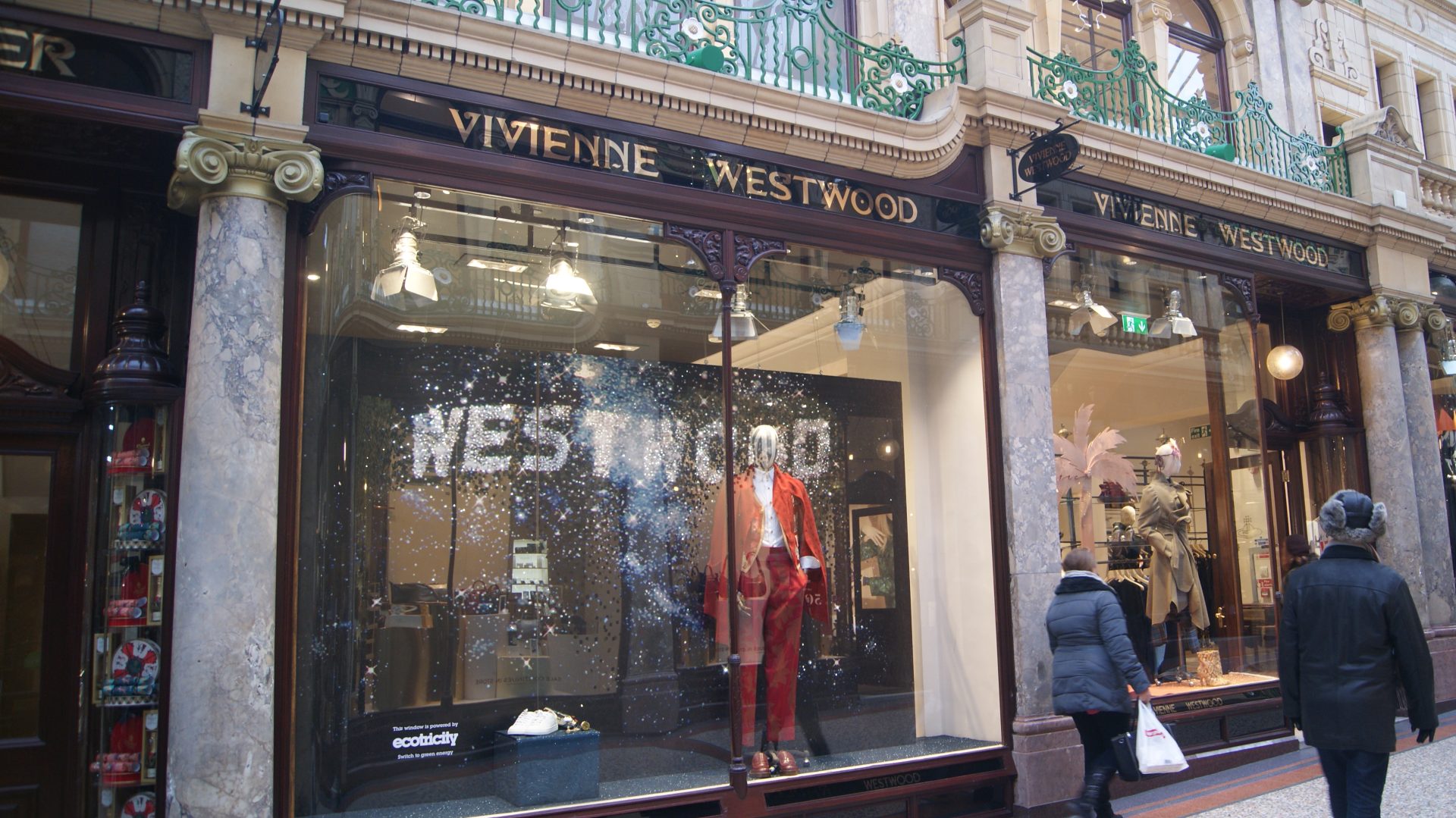
Over the Christmas vac I was lucky enough to attend an exhibition on one of my favourite designers, Vivienne Westwood, at the National Gallery of Victoria. Rich in archival treasures, the display visually narrated Westwood’s career in all its exquisite technicolour, serving as a true testament to her commitment to non-conformist aesthetics. Alongside the clothing, one of the most memorable aspects of this exhibition was the selection of quotes by the designer weaved amongst the mannequins, primarily the one displayed above the entrance: “I never look at fashion magazines. I find them boring”. This statement encapsulates Westwood’s disdain for the social politics and conventionality she deemed characteristic of the fashion industry. A notorious pioneering figure of the punk movement, founded in its immovable notion that fashion should be born from individuality, Westwood’s designs are the product of her belief that fashion is rooted in originality, a creative medium for the outward expression of the individual. Her disdain for the hyper-consumerism rampant in the fashion industry – “I don’t feel very comfortable defending my fashion except to say that people don’t have to buy it” – reflects her enthusiasm for reworking what you already have, rejecting the idea that to be fashionable is to constantly be consuming and conforming. For Westwood and her punk contemporaries, there is no such thing as to be ‘fashionable’, and if that is what you are aspiring to then frankly you’ve missed the point entirely.
This exhibition inspired a great deal of reflection on my own attitudes to fashion and how I dress. As someone who likes to consider herself somewhat ‘fashionable’ (or at the very least someone who takes an interest in fashion) I feel as though this individuality which Westwood posits as so central to personal style has become lost, muddied by the rise of visual social media, which allows us to access trends, and thereby adopt them, at an ever increasing rate. Fashion is no longer primarily a medium built on originality, nor on individual expression. Contemporary fashion, by which I refer to the manner in which fashion is consumed by the masses (not strictly runway or editorial fashion) has become a careful act of self-curation. Our clothes and outward appearance contribute to a narrative which we wish to convey to the world, about us, our status, our intellect, and our person. It is driven by a kind of aesthetic cohesion, one which I think can be best observed in the compartmentalisation of fashion into countless ‘aesthetics’ and ‘cores’. Don’t get me wrong, defined styles with their own aesthetics have always existed, Westwood herself found affinity with the punk movement which can be viewed as its own ‘aesthetic’. An identifiable visual code has long been a core part of countless sub-cultures and minority communities for whom fashion becomes much more than frivolity, rather aiding representation and articulating a desire to be seen. However, what I am observing now is less an allegiance to a sub-culture than what I deem to be a kind of binary categorisation, one which is driven by this age of fast fashion and excessive consumerism which demands us to be always chasing the latest trends.
As we live in a time dominated by visual forms of social media (think sites such as Instagram and our much beloved Pinterest) it is no longer entire cultures or corporations who feel the need to curate a kind of personal brand image, it’s now individuals. We face a compulsive desire to turn our lives into uniform and aesthetically pleasing Pinterest boards. This is killing our creativity. Personal style is built upon plagiarism. In any other art form, making a carbon copy of another’s work and branding it your own is almost always frowned upon, and yet in fashion it appears to be rebranded as ‘inspiration’. Today, the development of a personal style is less an act of originality, or of learning to sharpen our perception to distinguish our likes and dislikes and establish parameters of taste, than it is built upon imitating the fashion of those we deem ‘cool’ or conventionally attractive.
When confronted with this warped notion of ‘style’, defined by the next ‘aesthetic’ that the internet will try to shove down our throats, I am inclined to return to Westwood’s words of wisdom, that you do not always need to be consuming to be fashionable. There is no obligation to keep up with this insatiable trend cycle, now moving at a previously unprecedented speed, with the average ‘micro-trend’ cycle in 2025 lasting just three to five months. To be truly fashionable is to be both intentional and original, knowing what suits you and what you are drawn to, while being innovative and experimental. I feel like Oxford is an environment which fosters this kind of experimentation. In a city which embraces defined senses of personal style, where individuality is valued, what’s stopping you? Go digging in your wardrobe, and try looking at things in a different way, because you never know what treasures you might find.