

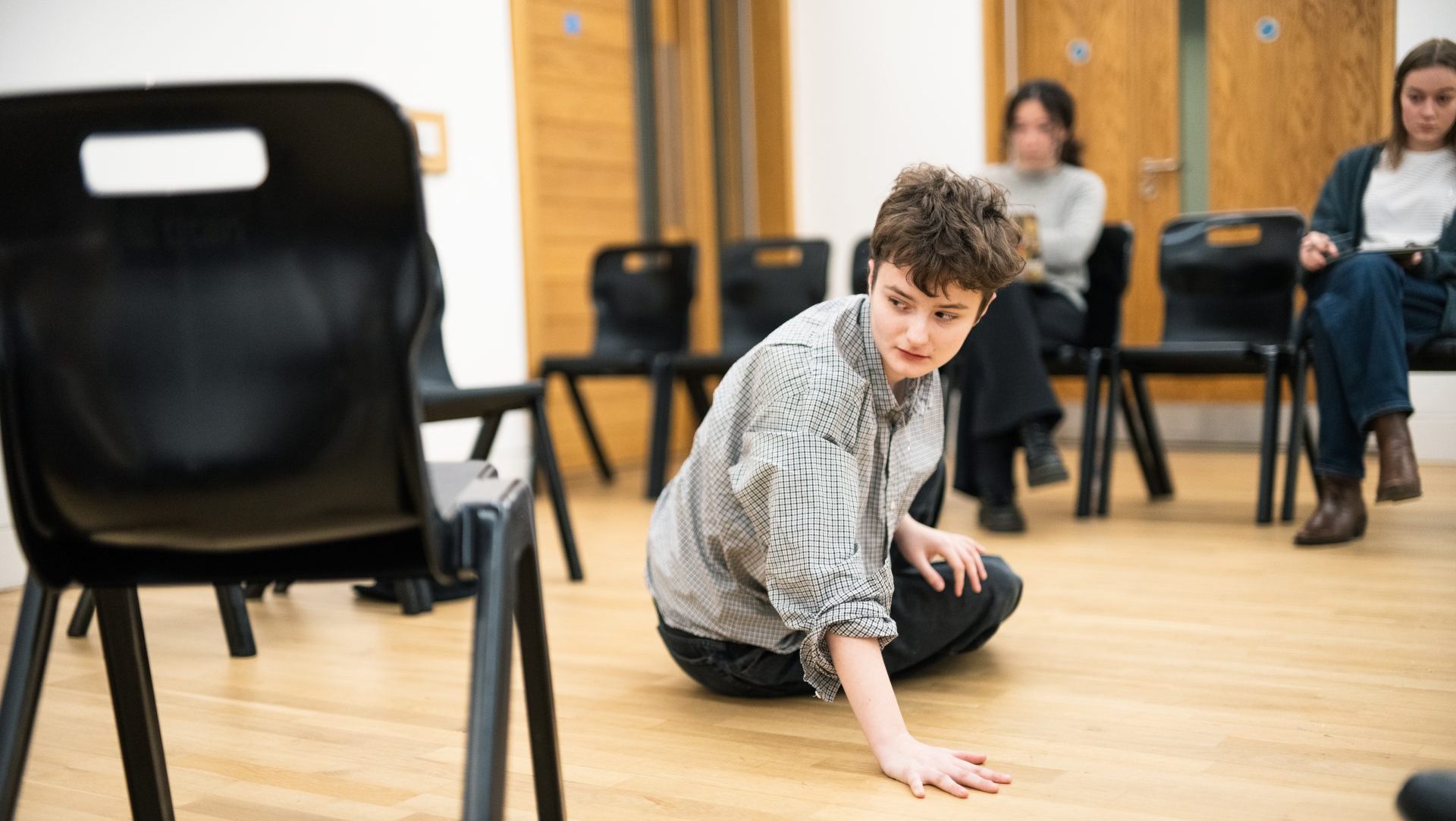
In a small, black-painted room on the top floor of a pub in Islington, known as The Hope Theatre, Madame La Mort, a play by Labyrinth Productions and Full Moon Theatre, and directed by Rosie Morgan-Males, was staged for the public for the first time, after a collaborative and, by all accounts, intense writing process.
The production is derived from a 19th century French symbolist play of the same name by Rachilde, the narrative of which is embedded within a 21st century plot. The protagonist, Juliette (Esme Somerside Gregory), suffering mental breakdown, uses the character of Rachilde’s Paul as a framework to cope with her neurosis, until she can no longer differentiate her own identity from his.
Despite the sparse and rather small set, the production makes innovative use of the space, projecting handwritten words on the back wall which become more and more confused as the play progresses. Strobe lighting for a scene set in a club, and a soundscape of recorded voices are likewise highly effective devices. In the midst of her psychosis, Juliette imagines her apartment as a decadent French salon. There is a sense of sustained irony as the stage and its props become the mise-en-scène of Juliette’s constructed reality; she parades around the set with glassy childish glee, engaging in a procession of kitsch that draws attention to its own artificiality. Yet overall, the play uses a minimal amount of props, facilitating the audience’s immersion into the landscape of the mind.
The production seems to delight in experimenting with form, swiftly switching between contrasting scenes that become more disorienting in line with the process of Juliette’s neurotic desubjectification. The feverish pace of the play, hurtling from one scene to the next, is pulled up short by moments of stillness, when it lunges and lands in the exploration of an image – a still lake, toast crumbs, the colours of a sunrise. One such extended pause comes with Juliette’s monologue, which is where Somerside Gregory, who wrote the passage herself, really excels. Her delivery was engaging and evocative, monopolising the audience’s attention with compelling intensity.
Juliette’s narrative is propelled by a psychology of paranoia, whereby the self is threatened by its own unaccommodated residues, and dissolves in a web of uncomprehended forces. A concatenation of short scenes traces Juliette’s self-disintegration as a result of the pressure from outside – the impersonal intervention of the therapist (Rohan Joshi), the anguished concern of her girlfriend, Lucie (Thalia Kermisch) – and paranoid fantasy from within. Lucie maintains a stubborn rationality in the face of her partner’s neurosis, as the prosaic clashes with the poetic. The intransigence of Juliette’s therapist is a source of frustration, as he, in the face of her breakdown, can only repeat ad absurdum the phrase: “We’ve talked about this.”
Juliette’s secure bearings in the world are eroded, as she is precipitated into a final and catastrophic decline, her subjectivity disintegrating under the pressure of her nightmarish delusions. The play’s emotional matrix is an acute claustrophobia, an oppressive sense of imprisonment, which, as the narrative progresses, extends from Juliette to the audience. There is no scope for distantiation here; the audience is immersed increasingly into Juliette’s psyche.
Themes of psychosis and suicide are difficult to portray with subtlety and sensitivity, particularly through the visual medium of theatre. As a result, the production, leaning as it does towards abstraction, tends to fall back on a vague romanticisation of its more hard-hitting concerns, which, although not handled without nuance, comes across at times as a little hackneyed.
The script, the product of a ‘writers’ room’, is an amalgamation of translation from the original French – a florid, baroque style – and modern insertions, creating “a polyphonic translation”, according to the programme. At times, this sits in uneasy juxtaposition, particularly when Lucie switches from her colloquial, doggedly rational idiolect to a more archaic form of beseeching speech. The heavy-handedness of several of the narrative jabs – the drug-laced cigarette, the figuration of death as a woman in a black dress, the suicide note – are likewise the result of appropriation from the source material, and have the potential to point up the convoluted nature of the play’s conceit.
The limitations of the set, and the run-time, although doubtless frustrating for the production team, ultimately work in its favour. Productions of this kind, encroaching into the realm of the abstract, often veer towards self-indulgence. Restricting the play to a vignette serves to concentrate its thematic and symbolic resonance, although one does get the sense that, hyper-aware of this restraint, they are attempting to pack too much into it.
Morgan-Males insists that it is still a “work in progress”; by the time of its scheduled Trinity term run in Oxford, and, looking further ahead, its staging at the Edinburgh Fringe Festival, the play may appear entirely different. In fact, the script was subject to heavy revision just days before this week’s performance. Its fluctuating nature as a piece of media grants it the ability to explore and incorporate varied angles on its themes, while retaining its core focus. As if to reflect the content, the very form of the work plays upon the spectacle of chaos and multiplicity.
Madame La Mort is a highly evocative piece of writing, creatively staged, and, on the whole, well-performed, if slightly let down by the contingency of its literary strategy. The script will, no doubt, develop and mature with revisions – it is this resistance to stasis that supplies the play’s appeal. Even if French accents are not really your thing, its commitment to innovation makes this play one worth watching.