

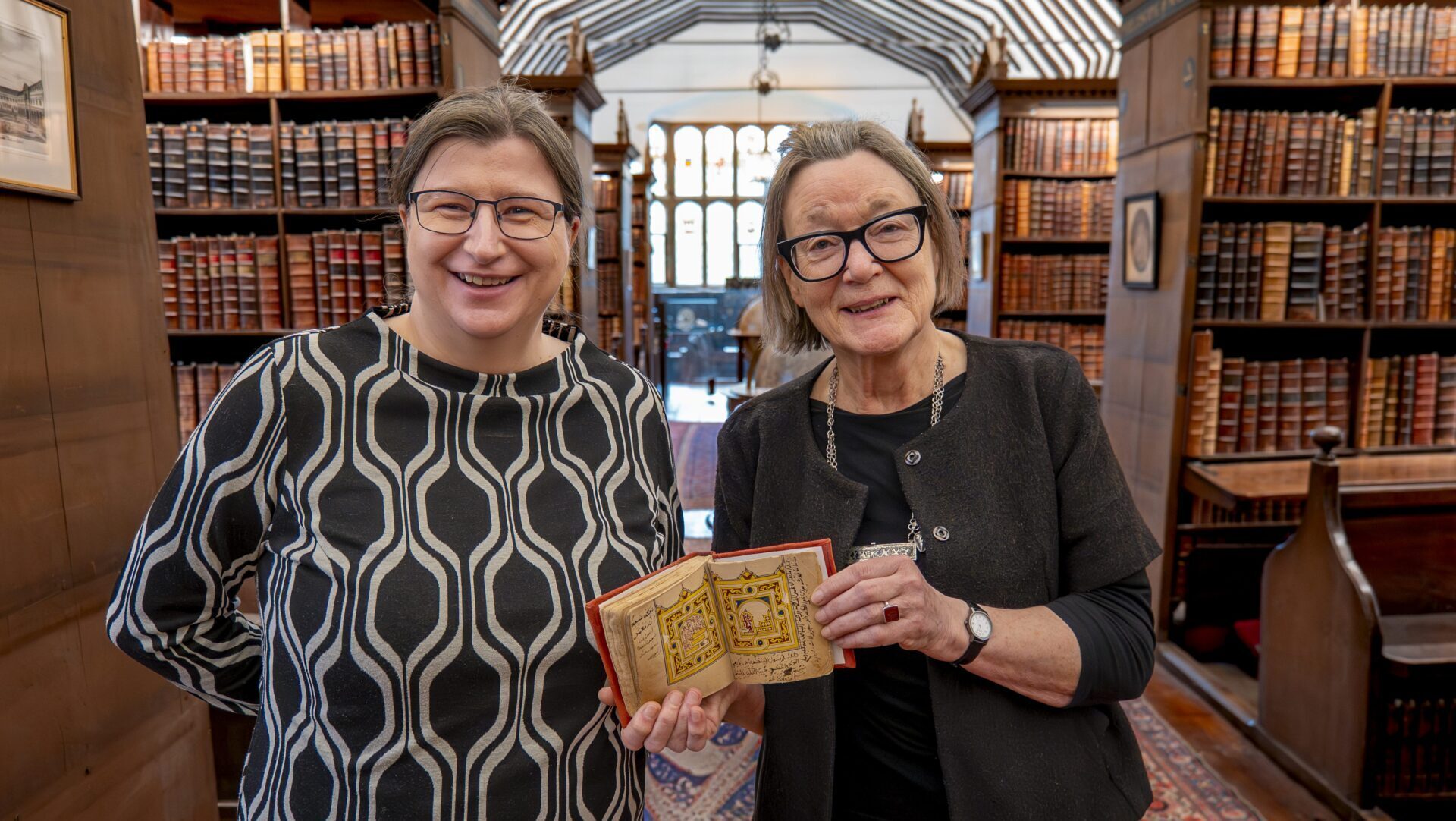
St John’s College Library has received a significant donation of Arabic-script manuscripts, along with early printed and lithographed books from Professor Julia Bray, who is an Emeritus Research Fellow in Arabic. Known as the Bray, Ferrard, McDonald Collection for the Study of Arabic-script Books, the collection includes 17 manuscripts as well as printed and artists’ books in Arabic, Persian, Ottoman Turkish, and Urdu.
The collection reflects the book culture of the historic Islamic world, from the 15th to 20th centuries. The items include student copies, devotional texts, and popular editions that bear marks of use, annotation, and ownership and were produced cheaply in vast numbers.
Professor Bray told Cherwell it is this wear and tear that makes the collection important: “Most of them are heavily used, with thumbing, scribbles, annotations, damage and mending. The damage means you can see what they’re made of and how they were made. The notes and scribbles could tell all kinds of stories.
“This is just the kind of thing that book historians are interested in now. Books are social history as well as text history and intellectual history.”
The core of the collection was acquired in the 1960s in Istanbul by Michael McDonald and Chris Ferrard, while they were students at the University of Edinburgh, benefiting from Turkey’s 1920s language reform, which left a generation unable to read Arabic script and rendered such books of no value to their owners.
The manuscripts they purchased are predominantly Arabic grammar textbooks, produced over several centuries in the Ottoman Empire for Turkish students in a higher-education system that required Arabic to access standard theological and philosophical works, alongside other subjects and a small number of Persian manuscripts. Additional printed and artists’ books were later acquired by Professor Julia Bray through gifts, chance purchases, or during her student years, with all items fully provenanced in the catalogue.
In addition to the bulk of Arabic texts, the collection also includes West African manuscripts written in two distinct scripts. Professor Bray told Cherwell that they present “stunning (and stimulating) examples of visual design”.
Particular attention is also drawn to the nineteenth-century printed and lithographed books from the Middle East and India. During this period, manuscript, print, and lithography coexisted, prompting questions about why type and lithograph imitated manuscript styles, and why manuscripts, in turn, copied printed texts.
As explained by Professor Bray, the concept of a hands-on teaching collection developed gradually alongside the growth of book studies. St John’s College was selected as the recipient of the donation due to its commitment and capacity to conserve and provide access. Professor Bray told Cherwell that the collection’s contrast with the College’s much grander Laudian Islamic manuscripts “enhances both collections educationally”.
Extensive further reading is now available online via SOLO, alongside a dedicated PDF guide accompanying the collection.