

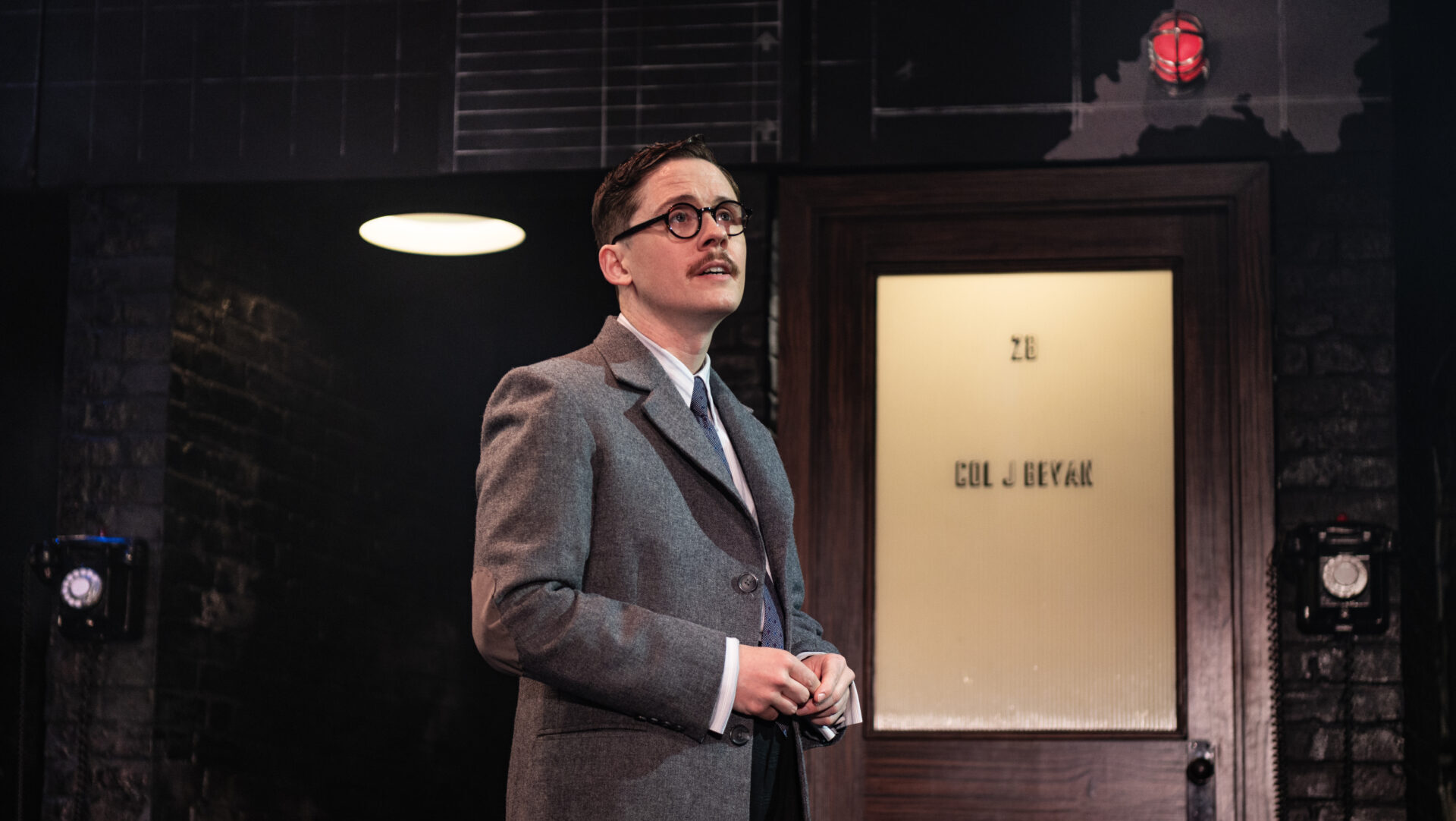
As a history student, you occasionally come across stories so strange they feel almost fictional. Operation Mincemeat is one of them. In 1943, British intelligence attempted to deceive Nazi Germany about the Allied invasion of southern Europe by planting false documents on a corpse dressed as a Royal Marine officer, letting the body wash ashore in Spain, and hoping the Germans would take the bait. Against all reasonable expectations, the plan worked. 80 years later, the story has found a second life on stage – though perhaps not in a form its architects might have anticipated. The musical Operation Mincemeat, currently touring the UK, turns the entire plan into what actor Seán Carey cheerfully describes as “a five-hander gender swap show about tricking the Nazis with a dead body”.
Carey plays Charles Cholmondeley, the MI5 officer who helped devise the plan. Like the rest of the cast, however, he spends much of the show darting between a multitude of other roles, switching accents, costumes, and personalities in seconds. Just five actors play a total of characters that lingers somewhere around the 85 count, turning one of Britain’s most elaborate deception operations into something resembling theatrical controlled chaos. Yet, behind the rapid-fire comedy lies a story rooted firmly in the lives of real people. When I ask whether playing a historical figure carries a particular sense of responsibility, his answer is immediate: “Yes, 100%. 100%.”
When Carey met members of the Cholmondeley family, seeing the premise of the show written down initially made them wary. “They were quite kind of nervous to see it”, Carey explains. “When they see on paper, oh, it’s a comedy about this kind of subject, there’s this worry that there might be maybe a mean-spiritedness.” What reassured them, Carey thinks, was the show’s tone. Operation Mincemeat embraces the absurdity of its story, but never entirely forgets the human reality behind it. “The beautiful thing about this show is that it’s very, very funny and very, very silly”, he says, “but it also treats the subject matter with a lot of respect”.
In some ways, the real operation already contains the strange mixture of humour and darkness that the musical leans to. For Carey, the sheer implausibility of the story is what makes it theatrically irresistible. “It was a really crazy plan”, he says. “It’s so much stranger than fiction that there are elements that were really, really funny and really silly and really macabre.” In fact, some of the most extraordinary details never even made it into the show. When researching the operation, Carey discovered that an American pilot who crash-landed around the time the body was discovered (the subject of the song ‘The Ballad of Willie Watkins’ in the musical) was actually asked to attend the autopsy and identify the corpse. Moments like that, he explains, were omitted simply because they were so outrageous audiences might not believe them. The real story, it seems, stretched credibility ever further than musical theatre.
Researching Cholmondeley himself, however, proved more difficult than researching the operation as a whole. “It’s very hard to research someone who was part of MI5”, Carey explains. “There’s very little about him.” Intelligence officers do not tend to leave extensive personal archives and as such, much of Cholmondeley’s life remains frustratingly obscure. One fragment, shared by his daughter, has stayed with Carey in particular: “One of the kind of lovelier things that his daughter shared with me is that he loved Tom and Jerry.”
It is an oddly fitting fact for a show that, as Carey admits, occasionally veers into something resembling cartoonishness. Carey describes the structure of the show as a kind of narrative misdirection – not unlike the deception operation itself. “You might think it’s this screwball kind of madcap comedy”, he says, “and then before you know it you find yourself crying at certain moments”. The emotional pivot works precisely because the humour lowers the audience’s guard. “Comedy is very deceptive”, Carey reflects. “It can catch you off guard, and once your guard is down it can really get through to you in a way that other mediums can’t.”
The story itself lends weight to that shift in tone. Operation Mincemeat was not simply the work of a few brilliant intelligence officers; it relied on an entire network of people across wartime Britain and the musical makes a point of acknowledging that diversity. There were, as Carey puts it, “these Etonian kind of well-to-do people who worked at MI5” – the archetypal figures of Britain’s wartime establishment. A figure that Cholmondeley himself was, as an ex-Oxford student. But there were also “people who worked in the typing pool”, clerks and administrators whose contributions were just as essential to the operation’s success.
And then there was Glyndwr Michael, the homeless Welshman whose body became the fictional ‘Major William Martin’. In life, Michael had struggled with poverty and ill health; in death, he became the unwitting centrepiece of one of the war’s most audacious deceptions. “He had a really difficult life and died in poverty”, Carey says, “but in his death, [he] saved hundreds of thousands of lives and this show acknowledges that in a way that maybe you wouldn’t be able to do in two hours in any other kind of medium”. It is one of the show’s most sobering truths – that the success of the operation depended on someone whose life had been largely invisible.
Perhaps because of this, Carey sees the story as more than a simple eccentric wartime anecdote. Its appeal lies partly in what it says about cooperation. “We live in a very kind of crazy time and very polarised time where people live in various echo chambers and kind of are afraid of each other”, he tells me. Against that backdrop, Operation Mincemeat becomes a reminder that complex problems rarely have simple solutions. “Human beings are messy”, he says. “We’re messy, we’re complicated… we’re born into things that we didn’t ask for. This is about people from every background coming together and doing something incredible. I think that’s something really special and something really necessary for now.”
If the themes of the show are unexpectedly serious, the experience of performing it seems anything but. In moving from off-West End, to the West End, to Broadway, and now a global tour, Operation Mincemeat has attracted an enthusiastic community of fans, affectionately known as ‘Mincefluencers’, who know every lyric and casting combination. On tour, however, many audience members arrive with no idea what they are about to see. “You can almost feel the audience kind of going, ‘What is this?’.”
Part of the fun lies in watching that confusion gradually turn into delight. The premise alone – a musical about wartime espionage performed by five actors playing dozens of roles – can take a little adjustment. But there is always a moment, Carey says, when the audience suddenly falls in love with it. “Pretty much everyone falls in love with it by the end, but it’s hearing when they fall in love with it, and they fall in love with it at different points.” For him, the turning point often arrives during a scene the cast knows as ‘the Pitch’, when Cholmondeley and his colleagues first present their elaborate deception plan. “I feel that’s where people get me as a character fully”, Carey explains. “Once that kind of happens, you’re like, okay, we’re off to the races now.”
What becomes clear over the course of our conversation is how much Carey enjoys being part of it all. Several members of the touring cast began their journey with Operation Mincemeat as understudies before stepping into the principal roles together, creating a company that feels remarkably close-knit. “I can go to work, and I just play with my mates”, Carey says simply. “And I make people laugh for a living.”
He recalls standing on stage during one of the tour’s early performances when the thought struck him mid-scene: how improbable the whole thing was. After years of working on the show in various forms – from understudy roles to the West End and now the national tour – there he was, performing one of the strangest stories alongside a group of close friends. In that moment, he says, he felt “this immense sense of gratitude” that something so unusual had become his everyday work. “My nine to five”, he reflects, still sounding fairly amused by it, “is just being dumb with my mates. It’s great. It’s so much fun”.
In some ways, that sense of unlikely collaboration mirrors the story at the heart of Operation Mincemeat itself. What began as an improbable wartime plan – devised by a handful of people with an audacious idea – has become a piece of theatre that continues to find new audiences. The musical thrives on the same mixture of ingenuity, eccentricity, and collective effort that defined the original operation. Perhaps that is why it works so well: beneath the jokes, quick changes, and absurd premise lies a reminder that history’s most extraordinary moments are often the result of ordinary people working together to attempt something that seems impossible.
Operation Mincemeat is running from the 31st March to 4th April 2026 at New Theatre.