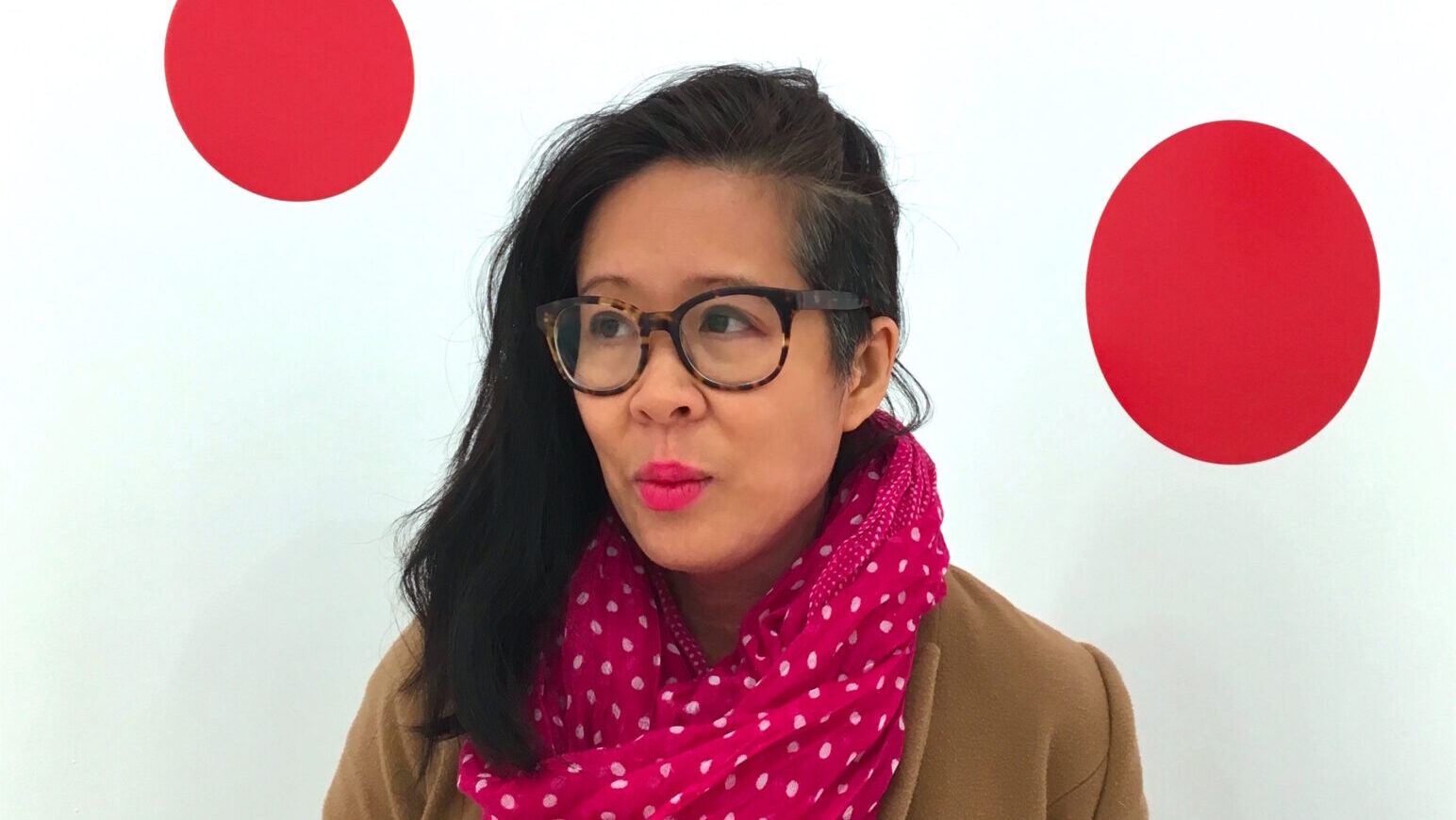
It’s 11:02am in New York when Lisa Ko appears on the video call. In Oxford, the sun is almost down. Thoughtful and self-aware, Ko sports a mullet and an assured smile. My first question is about NYC, the backdrop for Ko’s two novels The Leavers (2017)and Memory Piece (2024) both take place. How does Ko feel towards the city in 2026?
“I love New York. I identify deeply as a New Yorker,” she says. “It’s the place I’ve lived in the longest. They’re both very New York books. And, although I started writing The Leavers in 2009, a lot of the themes […] are obviously ongoing, and precede this moment, and are continuing and escalating in this moment. Whether it’s immigration detention, mass incarceration, ICE deportations, gentrification.” Here, her voice goes quiet, as if to address the weight of the words. She concludes on a positive note. “It’s such a large dynamic city. I feel like it both functions as a microcosm for how things can be, as well as a place of a lot of possibility and potential just because there is this really large mass of people that is there and is forced to interact in day to day life. There’s a lot of creative potential in that.”
In such a bustling city, I can only imagine how intense the pressure to optimise must be. In a 2024 interview, Ko talked about just that, explaining that she often experiences anxiety around how best to use time. Ko tells me she continues to have “a push and pull struggle” with technology, despite her longstanding relationship with the internet. Jackie, one of the three protagonists in Memory Piece, is a coder in the 90s, and writes a blog informed by Ko’s own online diary.
“I’m continually trying to figure out what is the best balance of ‘how can I shut my phone off’ or use it more wisely,” she says, carefully. “There’s a way that that kind of hyper-optimisation feels like just another part of very harsh hyper-capitalism, right? And that feels antithetical, I think, to art-making and relationship building, and life in general.” She laughs, before continuing: “[It’s also antithetical to] surviving in a way that isn’t all about, I don’t know… using our moments wisely before we die [rather than] being in service to some sort of larger capitalist project.”
I suggest this is a rather bleak state of affairs. Ko laughs. “Yeah! So I think sometimes I’m just like how do I do that but in a more analogue way? I do have these methods of routine and ritual, making sure that I make time for my art-making.” I ask whether Ko has felt the allure of the analogue movement currently sweeping the internet (see Forbes, The Guardian, and Dazed). She nods: “It’s something I’ve been thinking a lot about recently. I mean, Memory Piece talks a lot about the roots of digital surveillance, and how that’s being used more and more in a way that’s dangerous and harmful and scary. And I think as somebody who is middle-aged, and went through her younger years only engaging in analogue because that’s all we had, I think about that as knowledge I can bring to be useful in this time of surveillance and disassociation from tangible, physical objects. So I’ve been really returning to […] paper objects. I recently started a zine club.”
On the appeal of working with your hands, Ko describes the sense of community craft-oriented workshops can facilitate. “People are just so hungry to create together. I think because we don’t have enough opportunities to do that, or we feel discouraged from doing that. So [I’ve been] just seeing in myself the impulse and the joy that [comes from] being in a room together, or just cutting and glueing and working with [your] hands, and making something that belongs to us, and [that] we can use in whatever way we want.” There is a clear political implication to this material resistance, as well as a palpable nostalgia and pride. “I’m hearing about friends who have kids, who are under the age of ten, but have been really into cassette tapes and physical media formats that were around long before they were born.”
In a recent podcast, Ko had described how she loves a purge. She explains how, inspired by her artist character Giselle in Memory Piece – who burns a year of diary entries – Ko methodically shredded twenty years of personal journals during the COVID pandemic. I ask Ko about the appeal of a purge. What is she purging, and why?
After a burst of laughter, she explains: “It feels like an unburdening, in a way? On a practical level, in terms of moving, anytime anyone’s ever done a move who owns a lot of books, you start to question your habits of bookbuying.” At this, I find myself nodding furiously. Ko continues: “I recently actually helped my parents purge most of their belongings, as they’re in the midst of downsizing, and they’re older, so that’s been a very interesting process. Like, what do we want to keep?” Here, she shifts from practical concerns to implications for posterity. “I think also it feels like a kind of desire to control the past, or control the way the past is recorded or understood for the future, as if somehow that will help control the future. It’s a longing that’s never actually fully possible.”
Ko studied for a masters degree in librarianship and information sciences, an experience which feeds directly into concerns around survival of cultural information in Memory Piece. On whether studying librarianship changed her worldview, she says: “I think about archives and counter-archives a lot. Especially now, because we’re seeing such an acceleration of history being deleted.” Ko might be alluding to Trump’s history of firing state historians (such as ex-Acting Archivist, Colleen Shogan, and ex-Librarian of Congress, Carla Hayden) or his alleged destruction of historic state archival material.
“It’s nothing new but there’s been, especially in the U.S, a very public erasure, I think, of certain histories, of certain narratives, and actual literal destruction of public history and things in museums.” Ko’s voice again goes quieter here. She balances tact and duty. “It feels increasingly more important to create counter-archives and counter-narratives, [to] create repositories for the truth and for history. And we’re seeing it too in terms of so much of our histories have now migrated online, and that is in itself a very impermanent place. That is being controlled by a tech company. A website goes down and [a] large [part of] history goes down.”
At this point, I suggest that Memory Piece exists in itself as an archive item. It’s a fictional counter-archive of its own. “I really like that reading!” Ko says. “I think it was definitely one of the intentions. I never set out to write knowing exactly where it’s going to land, but as I was writing it I realised that was what I was trying to create. An archive, in a way, is like a time capsule.” Here, we briefly discuss the digital time capsule on Ko’s website, a mood-board style panel of hyperlinked images designed to reflect the setting of Memory Piece.
We shift to the topic of writing and style. Behind Ko’s poised prose, The Leavers seems to house a lot of anger, especially whenever Deming encounters racism, and Peilan encounters sexism. Do Ko see anger as a generative emotion for writing? “I mean I think it’s a necessary emotion, like all emotions. I think maybe it’s a question of how you feel and what you do with it. Can you use it in a way that feels skillful versus destructive, or feeling stuck there?”
“Anger and love and pain feel very related. They’re all sort of different sides of being human. So yes, it can be generative I think. But I don’t think it can be the driving or motivating force towards writing a book.”
In a 2017 interview, Ko questioned whether being a writer was a responsible decision. When I bring this up, she responds with surprise: “Wow, yeah, I forgot I ever said that!” On her literary identity, she says: “I think writing is just one of many ways I engage with the world. It’s not my only identity or my only job. I think that story-telling and recording are such valuable tools, and we really need them. Again, they’re not the only tools, but they’re one set of tools. And I think that’s a set of tools through which I can be useful.” Her characters Deming/Daniel and Peilan/Polly in The Leavers are similarly multi-faceted. Does she relate to them? “I think that part of being human and engaging with the world is wearing different hats and doing different things. And I don’t think I would be satisfied only writing. It also feels very isolating to be only doing that. But [writing] also feels like this constant companion.”
Both of Ko’s novels contain sprawling character histories, making use of past/present/future timelines. I ask Ko how she develops and manages these strands, on a practical and creative level. “I spend a lot of time writing really big, and then deleting and cutting and pasting,” she says, starting with practicalities. “[I’m] continually trying to tell myself that this is just part of the process and not to feel bad about it.”
On the creative side of developing a story, Ko explains that it’s all about balancing possibility with a clear vision. “You know, it’s hard, because you have to be open to what possibilities the process provides, whether it’s an opening at some point for a new character, a new timeline, a new setting. And you also have to, in the back of your mind, maintain that steady focus. What is the intention for the book? Where is the book going? There’s a lot of creating and paring down, and creating and paring down.”
Towards the end of our conversation, we face the future. Memory Piece contains a prominent dystopian element, with the final third showing its protagonists in old age in 2041, but the book isn’t marketed as dystopian. I explain how the dystopian element therefore blindsided me, and Ko laughs: “Right! Why are we no longer in the 90s?” She speaks to the reception of the novel on publication, and how it has changed since.
“I do remember a few comments. ‘2041 is too close for this kind of dystopia to happen.’ That level of state surveillance, military checkpoints in cities, really big income disparities. [Since then,] I’ve received comments from people being like, ‘oh yeah, it’s actually happening sooner than we thought.’ Now, 2041 feels too far in the future, because a lot of the things that are spoken about in the book around surveillance, state repression, and censorship are things that are happening now in 2026.”
On the unique challenge of writing about the future, Ko says: “It’s an interesting challenge, when you’re writing about the future. Because it’s obviously something that hasn’t happened yet, that you can project through imagination, and it’s really just an exercise on what would happen if the current reality keeps on proceeding. It’s not necessarily creating something out of scratch that feels far fetched. It’s just taking what’s happening right now and amplifying it in ten or fifteen years.”
“Yeah, it’s increasingly hard to believe that 2041, which initially felt very far away, is actually not very far away.”