

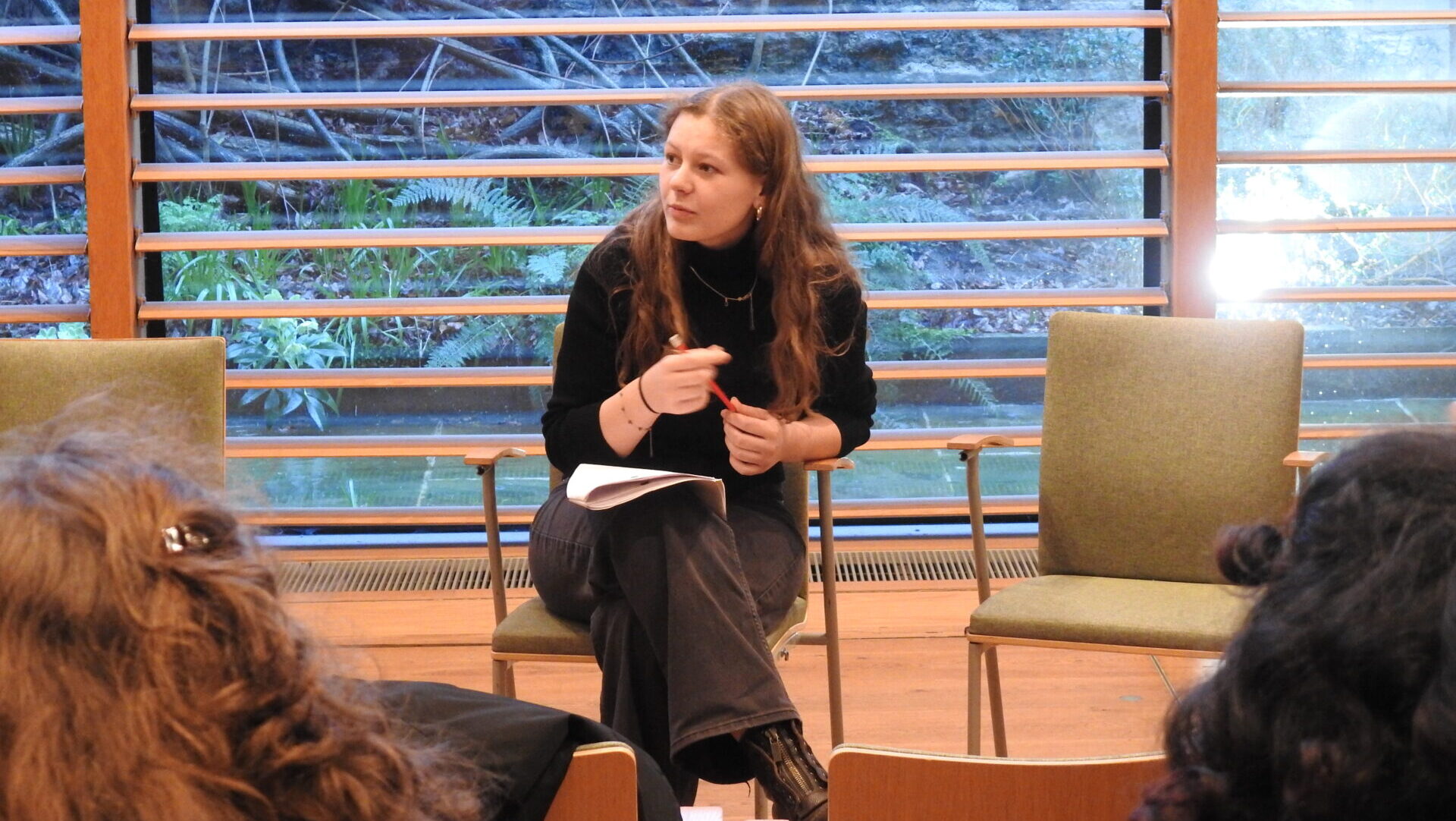
Oxford’s student drama scene has plenty of original writing based on fractured relationships, but none quite this random. Kilian King’s Brew Hill watches the deterioration of the romance between Nat (Trixie Smith) and Gordon (Jem Hunter), two broke former art students. Their romance is unusual in more ways than one: Gordon has an anxious condition which he comforts exclusively by checking flights to Berlin. The onstage action is interrupted by the presence of Flemish Renaissance painter Pieter Bruegel (Hugh Linklater), who appears in Nat’s ‘visions’. As the play progresses, the lines between the couple’s story and Bruegel’s become blurred. Cherwell went behind the scenes to find out more about what audiences can expect.
I watched the latter half of a full run of the script, sat behind a busy stage management team (Matida Lambert and Lucy Davis) taking notes on scene changes. Though outside of the performance space, the actors were highly energised. At points they leapt out of their seats to mimic the onstage blocking. The scenes I watched were highly comic, with Hannah Wiseman (Kirsty) especially making the mini audience (myself and the crew) laugh. Audiences will be surprised by how easy the cast makes it to laugh at the word ‘mmm’ alone.
After this light-hearted run had finished, the rehearsal turned to a more serious scene, exploring Nat and Gordon’s relationship. The jokes from before were laid aside and the cast became highly focused. The differences between Smith’s joyful, chaotic portrayal of Nat and Hunter’s quietly insufferable Gordon became evident. King’s feedback was both emotion-based and vibes-based, asking for a “little bit more deflation” in their tone, and later explaining one moment as “this is them when they’ve reached flow state.”
The cast have been active participants in creating the final product. Co-producer Marlene Favata explained that the script was only finalised about two weeks ago. Brew Hill has been with King for much longer. He told Cherwell that the historical aspect of the plot first wedged itself in his head a year ago, as whilst visiting family in Berlin he resolved to turn his love of Bruegel’s artistry into a play. The idea has now developed into an unusual mixture of techno and tragedy, with a side of medieval monologuing. Delving deeper into the metaphor behind the inclusion of Bruegel, King explained that, while the artist’s paintings look bucolic at first glance, “there’s a lot of darker, nastier stuff” revealed when one looks closer. This parallels the imperfections in the play’s central relationship.
Viewers may wonder what breweries have to do with a Flemish painter. The answer is nothing, but King thought Bruegel and ‘Brew Hill’ sounded close enough to work a brewery plotline into the script. Once he realised they actually sound pretty different, he was undeterred: “I thought, that can still work if the character is as dumb as me.”
Such self-deprecation doesn’t hold given his cast’s evident excitement towards his concept. There were points where cast members directed questions at King themselves, equally as curious to understand King’s starting intentions. On their reasons for getting involved, Smith cited her love of art, and Hunter told Cherwell he was “very interested in dreams”. These themes are reflected in the set, which aims to capture the play’s modern, naturalistic and historic, abstract elements. The back half of the stage holds the couple’s flat, and the thrust arrangement allows the front part of the stage to incorporate a variety of settings.
In answer to the question of why King cast each actor, he mentioned the chemistry between Smith and Hunter as well as Linklater’s strong monologue skills. The workshopping process seemed to have given the cast a charming closeness. Wiseman remembered lengthy discussions, one about Gordon’s character for “four hours” which brought up “every relationship trauma”. Much emphasis was placed on how much Hunter hates Gordon, while remaining convinced that he is a ‘self-insert’ from King. King was cautious to comment on whether Gordon bears his likeness.
The question of what the audience should leave thinking was difficult. The play can be interpreted in so many different ways. King joked that he’d like the audience to start their own breweries. Linklater wanted them to high-five (as one does after a good play). More seriously, King explained that the audience can reflect on the unease created when “one person wants to stay and one person wants to go”. For Favata, this reminds her of school friends left behind when she moved to Oxford. Wiseman also related it to friendship. Hunter’s idea was most poignant: his takeaway from playing Gordon is that “just because you have good intentions doesn’t mean you can’t hurt someone.”.
I’d already been partially convinced by Assistant Director Roselynn Gumbo’s promotional coasters (ingenious, given the play’s focus on beer). Spending time with Pecadillo Productions made it even clearer that their work is something unique. The play is a nod to Renaissance artistry that stays on the right side of pretentious. In one word? After some scrambling, different cast members suggested ‘community’, ‘escape’ and ‘techno!’. Without a doubt, something good is brewing.
Brew Hill runs at the Burton Taylor Studio, 17th-21st February.


 and Gordon (Jem Hunter).)