

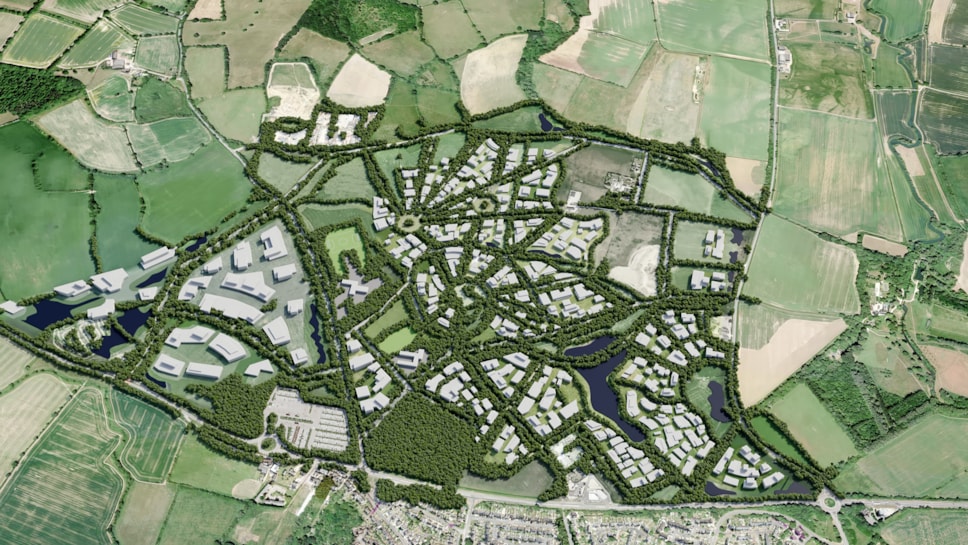
West Oxfordshire District Council has approved plans for a new carbon-neutral village near Eynsham as part of the West Oxfordshire Local Plan 2031, a framework adopted in 2018 to improve infrastructure across the district.
The proposed development, Salt Cross Garden Village, will include 2,200 new homes, a science business park, and community facilities such as schools and employment opportunities, according to the council’s website.
A spokesperson for the West Oxfordshire District Council told Cherwell that Salt Cross “was one of a number of strategic-scale site options that were considered in order to assist neighbouring Oxford City with its unmet housing need”.
They added: “It will be an exemplar community built to garden village principles with the need to tackle the climate emergency running through its core.”
Promotional material for the Salt Cross described the neighbourhood’s philosophy as having “climate action at heart”, balancing the “benefits of vibrant village life with the beauty and delight of the countryside”. The material emphasised the village’s focus on sustainability, with affordable homes and “opportunities to grow food locally… through community gardens, allotments, and edible planting in public spaces”.
In early January, a government inspector confirmed that the town’s Area Action Plan (AAP) met standards for approval. The inspector’s report, according to the Ducklington Parish Council website, “fully supports the Council’s strategy for delivering a climate-conscious, well-designed and future-ready community” and confirms that the council’s flagship Net Zero Carbon Development policy is “justified, effective, and fit for purpose”.
The approval follows protracted disputes between planning inspectors and local authorities over the village’s environmental obligations. In 2023, government inspectors published a report questioning the council on Salt Cross Village’s net-zero emission goals and whether it was consistent with national policy. Climate group Rights Community Action (RCA) subsequently challenged the report, taking legal action and arguing that the national policy was out of date.
A High Court judge then ruled in 2024 that inspectors “incorrectly applied national planning policy to proposals” for the homes in Salt Cross Garden Village”.
Asked how the plans for the village were altered between the inspectors’ 2023 rejection and recent approval, the West Oxfordshire District Council spokesperson told Cherwell: “Following the Inspector’s initial report in 2023 and the subsequent legal challenge, the council commissioned further evidence to support its zero-carbon ambition.
“The updated evidence considered a low-carbon option and a zero-carbon option, concluding that the latter was far more effective… but would be no more expensive to implement.”
They went on: “Based on this updated evidence, the council put forward a revised version of its zero-carbon policy which… retained the core requirements for 100% renewable energy and energy-based metrics.”
Construction on the village is planned to begin in 2030 and last for about 13 to 14 years.