

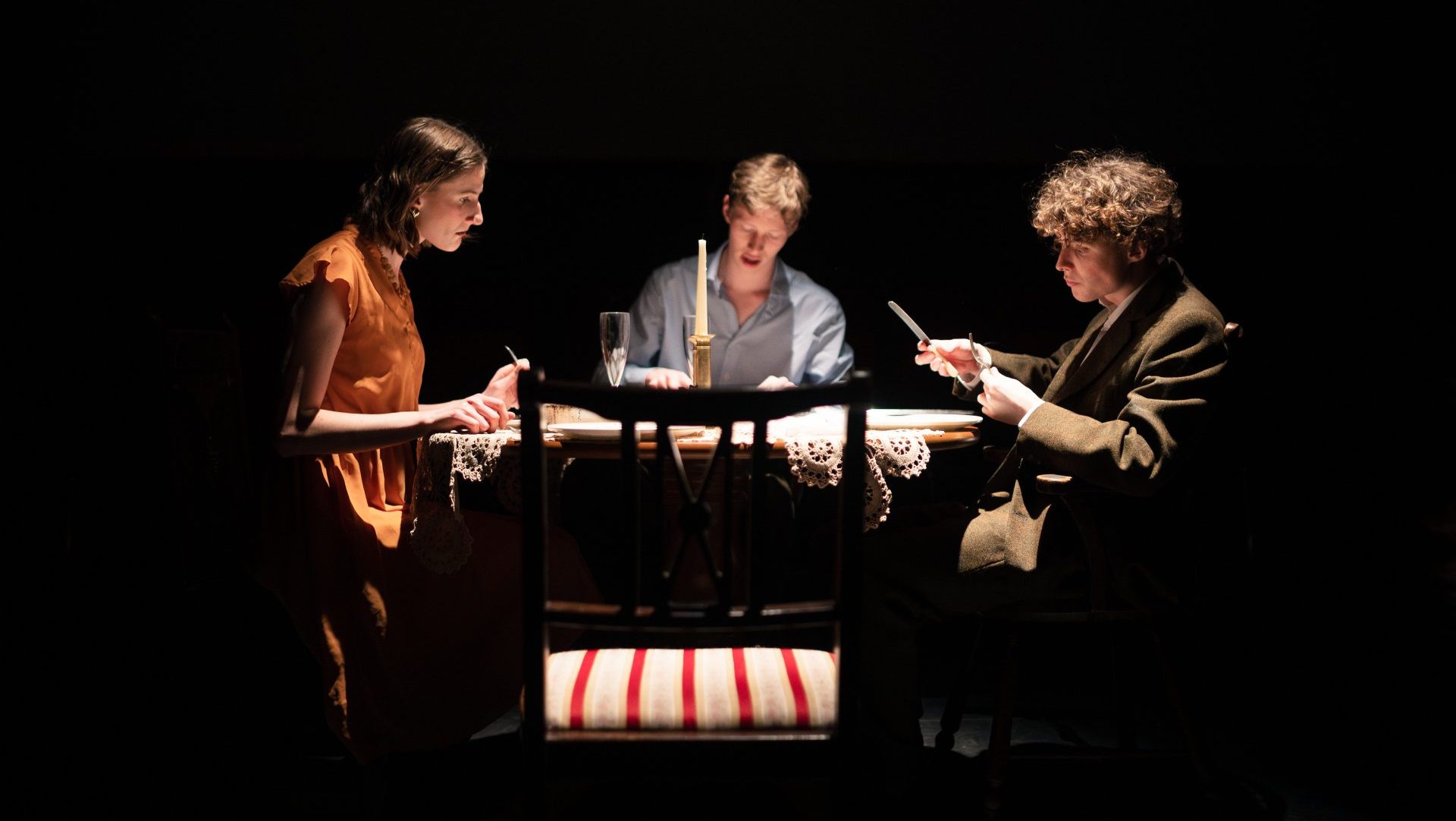
Crazy Child Productions staged a genuine and thoughtful adaptation of Tennessee Williams’ The Glass Menagerie. The play follows the Wingfield family, narrated by Tom (Oli Spooner) who tells the story of his life with his mother Amanda (Lyndsey Mugford) and sister Laura (Matilda Beloou). The plot focuses on Amanda’s struggle to find her daughter a suitable husband, after Laura has failed to make her own way in the world. The drama is filled with unexpected revelations and ultimately, an eruption of the family tensions that have simmered throughout.
I took my seat next to a smoke machine, which periodically coughed out bursts of fog, filling the space with a slightly musty smell. Quaint music underscored the conversations surrounding me on three sides, while overhead, a series of intricately crafted animal structures hung from the ceiling. The space was successful in creating a nostalgic atmosphere, but the O’Reilly felt slightly too big to evoke the sense of entrapment the play seems to demand.
The decision to stage it in the round meant at times that the play and the actors felt restricted. In the first few moments of the show, I was seeing a lot of people’s backs. The actors were sitting around a kitchen table which inhibited their movements. When they did exchange seats, and I came face-to-face with Mugford, I realised what I had been missing in the first few minutes. The acting in this show was wonderful, and it is a shame that it was hidden from my view because of the limitations of the staging.
The first lines delivered by Lydnsey Mugford in a bouncing southern American accent were utterly enthralling. She played Amanda with convincing sincerity. The actors excelled in silences too: the slight slouch of Laura’s (Matilda Beloou) shoulders and her careful reactions to her mother and brother’s conversation made her a pleasure to watch even when she wasn’t the focus of the scene. At moments, Tom (Oli Spooner) also doubled as stage manager, rearranging the set while his mother and sister spoke to remind us of his dual role as actor and narrator. Additionally, the fading of the light in tandem with Mugford’s softening voice as the scene transitioned provided another skilful combination of stagecraft and performance, drawing on the very murkiness of the play that the actors and directors were keen to express.
A highlight of this production was the staging of Amanda and Tom’s fight at the end of the third scene. Mugford’s varied intensity in her performance made these moments of heightened emotion even more startling. It was Spooner’s physicality, however, that triumphed. His crawling, loping motions as he approached Amanda created a real sense of threat and an aggressive release of repressed emotions. The choice in a later scene to have Tom lie on the ground and look up to the would-be stars while talking about his desire for adventure was another effective combination of movement and speech.
The second act felt more static and conversation-based than the first. While I believe this is largely down to Williams’ script itself, the structure of the act unfortunately drew attention to the struggles of working in the round, since I missed a number of conversations and interactions. Some of these interactions also relied on a visual effect to supplement the conversation, which, due to this issue of the sightlines, was lost on me. This was an unfortunate consequence of the staging choice for this play; the round demands near-constant motion, and yet that would not have done justice to Williams’ script. The directors, in their close attention to the text and compelling interpretation of it, cornered themselves with this particular staging. Yet Robson and Lacey-Hughes’ skillful direction was evident in the intricacies of movement, interaction with space, and lighting, which showed a thoughtful collaboration between directors, cast, and crew.
This show has certainly set a high standard for student theatre this term. Crazy Child Productions delivered an intricate, poignant show, despite the confines of its staging. This is a show that speaks to a generation of ‘Toms’, a generation trapped by responsibility and uncertainty, yet well aware of the potential of a life beyond their own.