

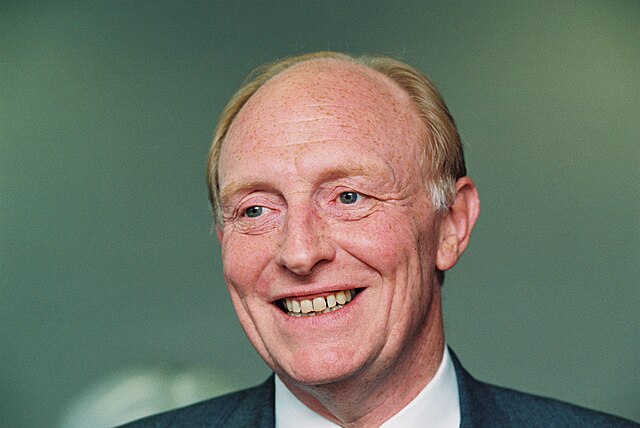
Neil Kinnock’s office in the House of Lords is small and tightly packed. One wall is entirely covered with books; the others are crowded with photographs, posters, and fragments from his political life. Besides his armchair hangs a photograph titled ‘Lord Kinnock makes his maiden speech’, taken during a family holiday where he delivered a mock address as part of a sketch. Besides that, hangs a poster labelled ‘Guide for Kinnock Drafters’, written by a senior civil servant when Kinnock moved roles at the European Commission – a satirical response, he explains, to his habit of rewriting the speeches drafted for him by officials. He insists he was never criticising the quality of the writing, only that “they weren’t Neil Kinnock, so they weren’t talking like I talk”.
Kinnock’s speaking style is distinctive, often placed within a long Welsh political dynasty – although he resists how that tradition is usually explained. He rejects the romantic explanations, it wasn’t “the pulpit or revolutionary fervour”, he says, at least not primarily. “We were always in tight corners…the main reason was to get ourselves out of trouble.” The result is what he describes as “a kind of teaching style”, developed, not to impress, but to persuade and defend. It’s a manner of speaking shaped by adversity and one he still believes others would benefit from adopting: “I wish more people would grab hold of it as it would make their lives easier.”
Throughout our conversation, Kinnock is funny, self-deprecating, and visibly uncomfortable with any suggestion of grandeur – despite his numerous achievements as Labour Party Leader, Vice President of the European Commission, and titan of Welsh politics. When I jokingly apologise for the difficulty of my questions, he laughs and says they might be better suited “to my psychiatrist maybe, if I ever had one!”. And when we turn to reflecting on his achievements, he adds quietly, “I think…that, that’s pretty good”. Humility is not a pose, as with so many politicians, but rather appears innate to his belief that progress is the responsibility of any politician, not something to be celebrated.
This attitude appears to be deep set and so the natural start of our conversation is to ask how he got into politics. His response, characteristically humourful, is to pull out the list of prepared questions I’d sent and say “much easier than any of these”.
He grew up in Tredegar in the 1940s, in what was then the South Wales coalfield, and understood early on how his community worked. As a child, he noticed that “all good things in our community…were all collectively provided at a standard no one could afford to pay for themselves, but because everybody chipped in a little bit these remarkable facilities were available”. Cultural experiences, education, leisure – these weren’t luxuries reserved for the few but shared achievements. By 14, he had read widely thanks to the local library and listened to orchestras, not because of personal wealth but because, as he puts it, “Tredegar, like a lot of working-class communities, had enormous cultural aspiration”.
The lesson was straightforward: “The general wellbeing of communities, enjoyed by individuals, came from collective contribution and organisation.” Politics followed naturally. “To me it was obvious that more needed to be done…that the only way to get those improvements was to organise and that meant joining the Labour Party”. He joined on the 1st January 1956, three months before his 15th birthday, having been granted special permission.
At Cardiff University, organising was the natural next step. He joined the socialist society and helped build a membership of around 700 in a student population of just over 3,000. Leafletting one day, he met Glenys Parry; they went on to marry a few years after graduating. After university, he worked as a tutor for the Workers’ Educational Association before being selected, to his astonishment, as the Labour candidate for one of the safest seats in the country. He was elected to Parliament in 1970 at just 27 years old. With characteristic bluntness, he reflects that it “wasn’t attribute to my brilliance…it was just pure bloody luck”.
“I never regretted it”, he says, “but I did think, when we had a very young family, whether it was sensible”. It was Glenys who made it possible. Because of her, “I was able to sustain a very high level of constituency and political activity while she effectively brought the kids up…I couldn’t have done much without her, yeah”. He says the last words slowly, after a long pause.
His election at 27 made him one of the youngest MPs in the House. When I ask what he wishes he’d known when he first stepped foot in Parliament, he answers honestly: “What do I wish I knew? A lot!” Eventually he replies, “I wish I’d realised when I got in here that it is worthwhile becoming a master of procedure and really comprehending the opportunities”. He describes discovering, years in, that requesting funding early in the financial year made approval more likely – “I had more pelican crossings than anybody else in the United Kingdom!”. Later, he also realised that “if I allied myself with the benefit officers in my constituency…I could always nudge a little bit extra by pleading individual cases”. “I wish I’d known it from the day I arrived.”
This attention to process – to the particularities of how institutions work – underpins what he considers his most meaningful achievement. When I ask what he is proudest of, he answers immediately. Contrary to what one might expect, it’s nothing to do with his time as Labour leader: “I think probably getting the international maritime organisation conventions turned into European Union law.” These reforms “transformed the quality of shipping” and contributed to the “safest seas in the world”. He then lists car crash testing regulations; transport treaties with Switzerland; and reforms within the European Commission. “You never see the words European Commission and scandal in the same sentence…because of the reforms we made”. He pauses, “I think that, that’s pretty good”.
Some decisions linger longer. “You think about regret way more than you think about success.” He pauses again before turning to his decision to campaign against remaining in the Common Market in the 1975 referendum: “I’ve thought about my decision to back the campaign quite a lot, yeah. How things might have been different.” He laughs briefly, “Christ, this is fifty years ago – more than twice your age!”. At the time, he says, backing the other side would have seen him dismissed “as an eccentric leftist”.
But he is careful not to frame this as uncertainty over the European Union itself – in fact, he is arguably the most pro-European leader in the history of the Labour Party. What interests him though is what the issue reveals about political attachment: “On issues like that, what begins as policy stances can become issues of almost religious devotion – they grow deep roots.” Shifting the party’s position on Europe whilst serving as leader in the 1980s was not a matter of decree or discipline, but persuasion: “You can’t do it by any arm twisting or wrist breaking.” The work was slow, incremental, and to do it properly, he recalls, took almost six years. After “a religious fight”, as he describes it, the Labour party “became the most pro-European party in the United Kingdom”.
This idea – that progress is incremental and collective – sits at the centre of his politics. “The power of cooperation is slow but relentless”, he tells me, “it’s how things get done. How good things get done”. He describes himself as holding “the values of a democratic socialist” and insists that compromise is not weakness: “People with deep convictions are never worried about making compromises, because they know that progress is incremental.”
That belief was clearly a shared one. We are speaking two days after the second anniversary of his wife Glenys’ death, after almost 60 years of marriage. When he speaks about her, the shift is immediate – quieter, slower, more deliberate. He recalls watching her work as a Member of the European Parliament – “and a very effective one”. “She used charm whilst other people used tanks.” He remembers seeing her smiling in conversation with a group of Christian Democrats, later explaining that she had secured their agreement to an amendment on international development. When he dismissed them as “German Tories”, she replied that she believed in “getting half a loaf and then going back for another half until I get the whole loaf”. He recalls teasing her in response, “so, you’re not in favour of compromise”, to which she replied, “why should I [be], I married you”. He smiles at the memory and then adds that she once told him, “I didn’t marry you because you’re handsome, obviously, but you’ve always been interesting”. There is a long pause. “She was brilliant, yeah she was.” He quietens and for a moment our conversation stops altogether.
When he speaks again, it’s to return to his cooperative values. His anxiety about contemporary politics is rooted in the abandonment of these. “What worries me most of all is populism”, he says, calling it, “the mobilisation of ignorance, by the manipulators”. He is blunt about figures like Farage and his associates. People must “realise just what a bunch of sharp operators” they are, “they’re wrong on every count…they are sensationalists, they are the Brexiteers, they are the rejectors of global responsibility and yet they blather on about global Britain”.
Still, he believes there’s hope: “Oh yeah, we can beat them,” he says – but “we’ve got to beat them on our terms not theirs”, through accomplishment, exposure, and serious scrutiny.
He has hope too for young people and his advice is characteristically unvarnished: “Be yourselves. No one else is inherently better or worse than anyone else; you prove yourself by hard work and good deeds, and if you do that you’re going to have a lot of fun along the way.” He jokes about having worked very hard at being a clown at school – “a lot of fun” but “bloody awful” in terms of achievement.
My final question turns to the bookshelf in his office when I ask what one book he would read for the rest of his life. He instantly reaches for R.H. Tawney’s Equality. Flicking through it, he finds amid the pages notes from a speech and then begins to read aloud from the opening page: “Matthew Arnold observed that in England inequality is almost a religion. He remarked on the incompatibility of that attitude with the spirit of humanity, and a sense of the dignity of man as man, which are the marks of a truly civilised society. ‘On the one side, in fact, inequality harms by pampering; on the other by vulgarising and depressing. A system founded on it is one against nature, and, in the long run, breaks down’.” “This is the basis to it all”, he says.
We finish with him still holding the book with a sort of reverence. By the end of our conversation his politics feels unmistakable – not rooted in gesture nor rhetoric, but rather patience, organisation, and an insistence that progress is something made together. In a political moment increasingly dictated by urgency and spectacle, Kinnock’s convictions feel almost unfashionable. But sitting in his quiet office, his steadiness cannot be mistaken for nostalgia.