

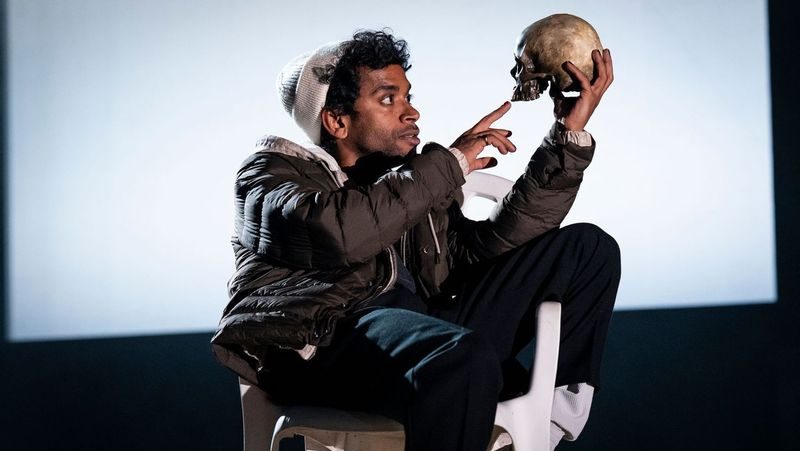
There are few literary characters so fully developed, and yet so liable to re-interpretation as Shakespeare’s Danish prince. In its 400-year performance history, continual stagings have still not mined the text for all its potential resonances, such that the world of Elsinore, while being instantly familiar, is always unexpected. This month, Hamlet returns to the stage in a new production soon to be released on National Theatre Live, following its staging last autumn.
With a run time of two and a half hours (take notes, Kenneth Branagh), Robert Hastie’s heavily cut production narrows its focus to an exploration of the prince’s psychological state, whilst bringing out the humour inherent in his madness. Hiran Abeysekera gives a captivating performance in the titular role, bringing a frenetic vivacity to the young prince’s speech.
Throughout, Hamlet appears to inhabit a parallel mental universe, from which to observe the denizens of Denmark’s court. From his first appearance, clothed in a black suit and an air of cryptic truculence, his difference from the rest of the court, assembled in a mood of celebration, is manifest. Hastie draws this out even more, freezing the rest of the cast and using a harsh spotlight to isolate the protagonist from the action. Abeysekera delivers his soliloquies directly to the audience, questioning them and raising laughs through his assumption of intimacy. This is compounded when he directs lines conventionally spoken to Horatio, his usual confidant, to the audience instead (most notably before the play-within-the-play), enlisting them as accomplices in his plot to unmask Claudius’ guilt.
Abeysekera puts great emphasis on each moment of antanaclasis, engaging in a witty form of double-speak that serves as both a shield and a weapon, while drawing attention to the opacity of language itself. As the play progresses, his manipulative repartee becomes less sardonic and more grimly enigmatic, exploding into visceral rage. The spiraling intensity of Hamlet’s neurosis propels the narrative, as the audience becomes increasingly drawn into its emotional matrix. When Hamlet shoots Polonius with what at first appears to be a finger-gun, but then is revealed as an actual gun, and when he gestures wildly towards an empty chair, where the ghost of King Hamlet traditionally appears, the entire play becomes distorted by the pressure of Hamlet’s psyche. The audience is given no access to objectivity, but is instead immersed in his “antic disposition”.
Hastie’s cuts and directorial choices, particularly in his staging of the soliloquies, mean that the figure of Hamlet entirely absorbs the audience’s attention, so that other characters become oddly peripheral. Claudius (Alistair Petrie) is an unemotional statesman, reserved in his villainy, to the extent that it is difficult to feel invested in his development. Gertrude (Ayesha Dharker), too, is oddly underdeveloped – the production does not exploit the fraught relationship between mother and son. It was gratifying to see the script circumvent the often-overblown Freudian interpretation of their intimacy, yet this comes at the cost of emotional vacuity. The ire of the so-called bedroom scene is utterly deflated, the acidic frisson excised from what should be the play’s emotional centre.
Humour is instead the keynote of the production, drawing on the ample comic resources already present in the tonal register of Shakespeare’s tragedy. Hastie is not the first director to lean into the play’s often-overlooked comedic elements; Sean Holmes’ 2022 production entirely overwrote the tragic genre, resulting in a hollowed-out comic pastiche of the play devoid of emotional depth. Hastie does not go this far. Much of the speech is ironised and delivered for laughs, such as Ophelia’s sarcastic promises to obey her brother, and unscripted movements are vivified by moments of physical comedy, such as when Laertes does a shoey as the Danish court cheer him on. Rosencrantz and Guildenstern are made entirely parodic – preppy, boarding-school types with whom Hamlet engages in flirtatious banter. Polonius is stripped of complex characterisation, represented as a docile, even likeable, ‘dad’ figure, existing mainly as a springboard against which Hamlet may display his eccentric wit. The players, in turn, are a comedic caricature of an amateur dramatics society. Although Hastie balances the humour and the tragedy more effectively than Holmes, the characters around Hamlet often veer too far into the farcical.
The enduring appeal of Hamlet, and the reason why it is put on year after year (much to the chagrin of the English A-Level student) is its capacity for innovation. There are innumerable opportunities for radical re-readings, from Frankcom’s gender-swapped production (2014), to Eyre’s exclusion of King Hamlet’s ghost (1980) – not to mention Disney’s The Lion King (1994), of course. Yet there is a distinct lack of novelty in Hastie’s play. The apparel oft proclaims the man, yet the choice of modern dress appears distinctly unremarkable. The humour, the fencing match, the fourth wall breaks – all these have become familiar, almost hackneyed, staples of the play’s performance history.
It’s difficult to pin down the production’s emotional core, for the precise reason that it lacks one. No particular theme stands out as the guiding principle, and each idea is engaged with only superficially, often sacrificed for the sake of a punchline. The production eschews even the most surface-level political engagement, cutting out extended passages of stage intrigue, and diminishing the external pressure from Fortinbras who is portrayed prosaically as an uncomplicated soldier in standard military uniform. The narrative appears oddly suspended, set in the modern day yet removed from real-world resonances. Such a frequently performed play demands innovation and fresh interpretation. It is this frustrating vacancy that, in the end, lets an otherwise well-executed production down.
Overall, Hastie’s direction is engaging, amusing, and (for the most part) faithful to the text, excelling particularly in its exploration of, and complete immersion into, Hamlet’s complex psychological state. Beyond that, the rest is silence.