

Paris is internationally renowned as a hub of creativity, inspiring artistic pursuits throughout its history. Its many galleries, including the Musée d’Orsay and the Musée de l’Orangerie, bear testament to its artistic credentials. Yet it is the Louvre that takes first place in global renown, with a firmly entrenched status as a ‘must-see’ on any trip to Paris. It was, in the end, the fear that we would be doing the city a disservice, as well as perhaps an inclination towards masochism, that led us to include a visit to the Louvre on our agenda.
In spite of recent events, the expected heightened security was nowhere evident, making one doubt if they’ve even got round to changing the video surveillance password yet. I wasn’t planning to pull an Arsène Lupin, but it’s nice to know that I could have if I’d wanted to. The apparent scarcity of museum staff in general meant that not only were vast swathes of the museum closed to the public, but there was no one to offer a guiding ball of string as we traced our way through the labyrinthine layout of the endless Ancient Greek section.
The Louvre has the dubious privilege of housing a vast treasury of objects, particularly antiquities taken from Greece, Italy, Egypt, and the Middle East. Yet the curators of such a wealth of alluring artefacts seem to have taken the bold creative decision to not curate them at all. Far from imposing any hint of organisational design, the approach was rather to indiscriminately pile every single object in the collection into unmarked display cabinets. The only reason that I was able to get anything out of the homogeneous stretches of ancient artefacts was because I already knew about them. When an Oxford education is a prerequisite to understanding exhibitions, what precise purpose is the museum serving?
Such a blatant refusal to explain the origin, design, or significance of these objects signifies more than indolence. It perpetuates the notion that art, and its comprehension, is the preserve of the elite – if you know, you know, and if you don’t know, we’re certainly not going to help you out.
Museums are, in their very conception, the only place where most people will be exposed to such recondite objects as Cycladic figurines and Persian bas-reliefs. It should not have to be spelled out that it is, therefore, their obligation to act as mediator, to translate the geographically and temporally inaccessible into the idiom of the present day. Yet the Louvre, in its refutation of accessibility, seems to follow the doctrine of Schopenhauer, that art must remain a sealed book to the dull masses. The majority of visitors, who missed the memo about the required pre-reading, will leave the museum no more enlightened about Ancient Egyptian society than when they entered. This approach exacerbates the issues caused by these objects’ contentious status: not only are they removed, often illegally, from their country of origin, they are not even dignified with a description. In the hands of curators, storied artefacts, interpretative keys to historical and cultural understanding, are reduced to lumps of metal and clay.
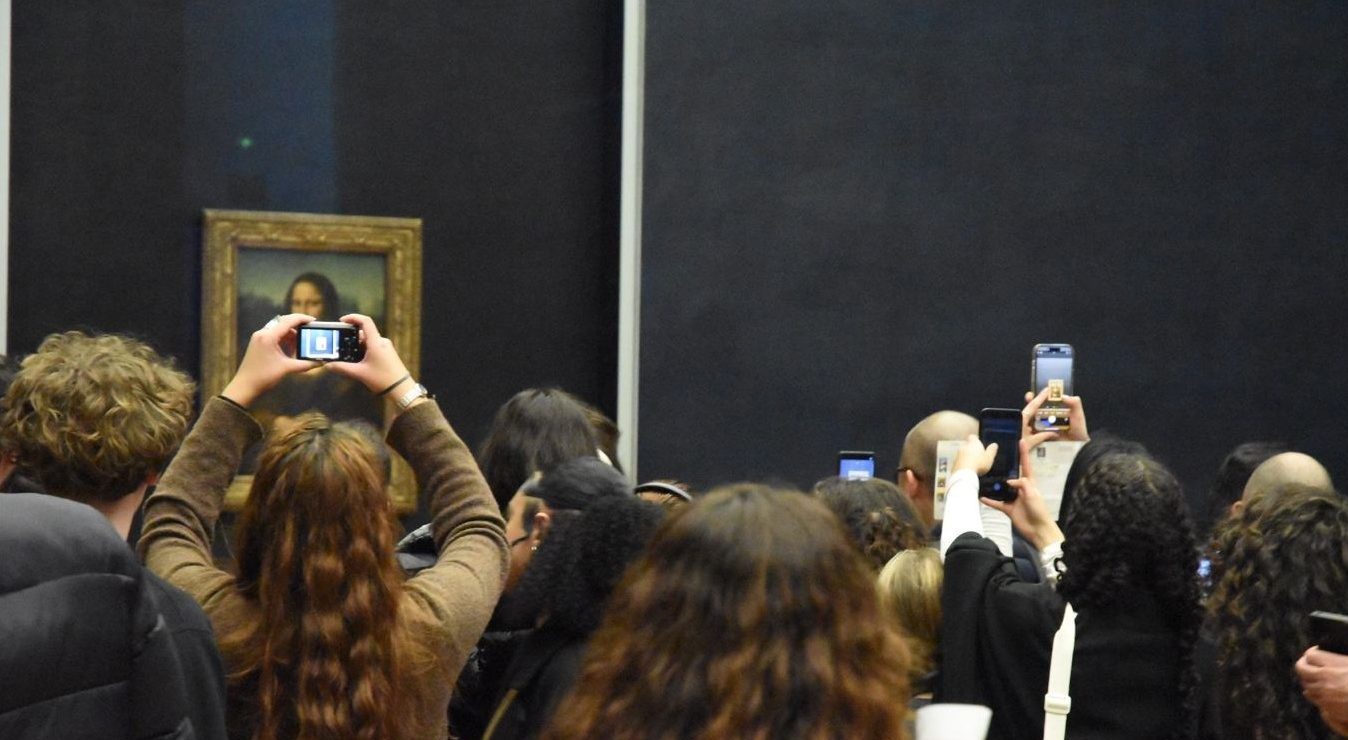
Putting aside the Mona Lisa, which is visible only momentarily, submerged behind an undulating barricade of iPhones, the keynote of the museum’s artistic programme appeared to be the spirit of French national pride. The highlights tour which formed the guiding principle of the map consisted mostly in portraits of French kings (ironically for a country that makes so much of its revolutions). You would never know that the Louvre housed such works as La Mort de Marat, Lady Macbeth Sleepwalking, and the paintings of Boucher. I found out that these were part of the collection only when I saw the postcard display in the giftshop. Not that I would have been able to fully appreciate them – the paintings were, for the most part, poorly lit and tersely labelled.
In the last month or so, the museum has sunk to even greater depths of incompetence with the unveiling of a new exhibition, the Galerie de cinq continents, with the avowed aim to “tell the story of humanity in all its diversity and richness”. The exhibition amounts to various figurines from disparate parts of the globe, primarily from Africa and Polynesia (unsurprisingly), sporadically dotted around in display cases like floating islands. The vast room, oppressively clinical in its blankness, was punctuated by vacuous paragraphs descanting on such profound topics as ‘belief’ and ‘authority’, the verbal glue inexpertly applied to manufacture a sense of coherence.
The main takeaway of the exhibition was the comprehensive failure to acknowledge France’s colonial past. Even where the origin of an object was specified, the legality of its acquisition was obfuscated by words like ‘collected’, as if it were an ASOS parcel. This laissez-faire approach was likewise applied to the display’s inclusion of actual human remains, with no attempt to contextualise or justify the curatorial choices. Its half-hearted effort to create a storybook tableau of global unity came across as patronising, and ultimately affirmed, rather than undermined, an implicit sense of colonial dominance. Bolstered by the perverse notion – maintained, it seems, primarily by those outside of France – that the Louvre stands as an enduring symbol of national pride, these artefacts are isolated from their contexts and co-opted as props in a farcical performance of Western superiority.
The oppressive crowds, the steep ticket prices, and the confusing layout all conspired to make the museum experience unbearable, even for the staunchest of French nationalists, and the immense shopping mall we had to get through before we could find the exit seemed to rub salt in the wound. The Louvre, like all the worst museums, is little more than a bulwark of outdated nationalism, a stain on the artistic pretensions of those who uphold it. In the end, its only beneficiary is the tourist trade, churning out an endless stream of Mona Lisa fridge magnets and pyramid keychains. Save your euros, and wait for the next revolution.