

When I wandered into Tingewick Hall on a cold, dark evening in seventh week, I was utterly unprepared for the madness that awaited me over the next three and a half hours. By the time I walked out of the John Radcliffe I had – both literally and figuratively – been transformed: armed with more insider hospital jokes and medical puns than I ever thought possible, and faced with the frankly impossible task of reviewing a pantomime whose absurdity could justify its own book. Still, I will impose upon myself the sentence of trying to do justice to a production that stands in a league of its own, and hope that the verdict you pass will spare my head.
Tingewick has deep roots in Oxford’s medical scene. The hospital Christmas pantomime dates back to the days of the Radcliffe Infirmary – now the site of the Schwarzman Centre – more than two centuries ago. It was in 1940 that the medical students first took charge, with earlier productions led mainly by nurses. The name Tingewick, originally styled “Tynchwycke”, commemorates Nicholas Tynchwycke, the first teacher of medicine in Oxford, and physician to Edward I in the 14th century. Today, each cohort of fourth-year medics takes to the stage under the direction of a select group of fifth years – the “Tingewick Firm”. The society’s status is written into the fabric of the John Radcliffe Hospital itself, which boasts a large hall and foyer bearing the Tingewick name.
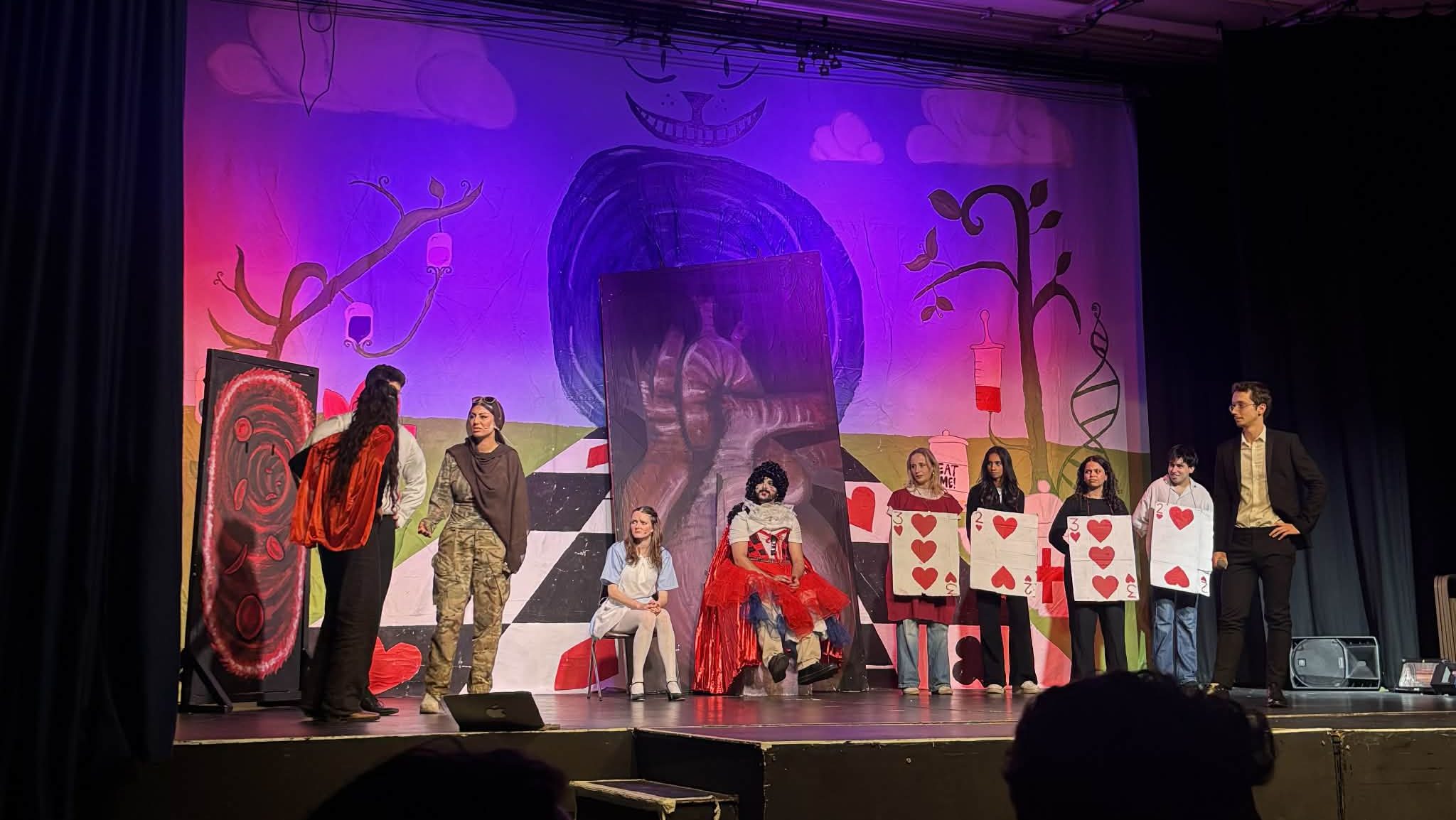
This year’s panto, Alice in Won-DRE-Land, is directed by Poppy Stafford-Dorlandt and produced by Anthony Vakis, with Wesley Donaldson as Treasurer. The title gives the game away early: yes, DRE stands for Digital Rectal Examination, the first of many, many medical gags. We follow Alice (Saskia Haines Francis) as she journeys through the body of Mr John Radcliffe (David Akanji), stricken by a mysterious illness, in search of six bodily “stones” that will allow Cathanos (Alice Wyles) to restore him to health. Along the way she encounters the Fluperheroes (Finn Galway as Clerk Stent/SuperVTMan, among others), assorted strange creatures, and the imperious Queen of Hearts (Anastasis Avraam) and her cronies.
Plot is not the production’s strongest suit. The story sprawls across eight (nine?) scenes, two acts, twelve musical numbers, and an unrelenting barrage of digs at tutors and consultants. But what it lacks in narrative tightness, it compensates for in sheer invention. The writing team – Faisa Ali, Natalia Nieora, and Lexie Pert, led by head writer Emily Semahegñe – have clearly thrown everything they have at this script. For those not steeped in clinical life, a good portion of the humour inevitably goes over the head: much of the clinical in-jokery was certainly lost on me. Judging from the constant, loud, and sustained laughter around me, however, it landed squarely with the target audience, who received a very healthy dose of medicinal comedy.
Musically, the show is remarkably strong. A standout sequence is a reworked ‘Bohemian Rhapsody’, staged while Alice is trapped in the brain and ambushed by animals escaped from testing. It combines some of the evening’s best vocals with sharply drilled choreography by Julia Louw and Kirsten Parsons, underpinned by live music directed by Shawn Lau. The band is a consistent highlight, managing to keep pace with frequent lyric changes and abrupt mood shifts, and special mention is due to cellist Emily Paterson, who navigated some technically demanding terrain with ease.
The overall vocal standard is impressively high for a student panto. Solos by Avraam, Haines Francis, and Ella Emery-Peters are particularly notable, and the ensemble numbers are generally clear, coherent, and rhythmically tight, despite the density of the rewritten lyrics. A show that relies so heavily on contrived lines and internal references could easily have descended into chaos; instead, the cast largely maintain control and clarity, even in the more frenetic set-pieces.
Visually, Alice in Won-DRE-Land is a feast. Under the leadership of Adithya Nair, set and costume design deliver an endless parade of inventive props and visual jokes, many of which reward close attention. The world inside Mr Radcliffe’s body is rendered with a gleeful disregard for anatomical realism but a keen eye for stagecraft. A particularly titillating and much anticipated dance number – led by Joy Sidhom, Cem Muminglu, and Jonas Krusic – more than lives up to the hype, drawing one of the loudest reactions of the night.
With a cast list as long as a hospital on-call rota, it is impossible to acknowledge everyone by name; among those who particularly stand out, whether for comic timing, vocal strength or sheer commitment to the bit include: Manon Roberts, Samuel Thompson, Luke Boulton, Josh Jankiewicz, Thomas Bowyer, Milind Khashu, Samuel Santhouse, Sophia Clyde, Daniel Cox, Aria Appoo, Ashley MaLauchlan, Matthew Brown, and Jack Grivvell.
It would be remiss not to emphasise that all this effort serves a purpose beyond entertainment. Tingewick 2025 is raising money for Oxford Hospitals Charity (which supports innovative research and some of the most vulnerable patients in the community) and Asylum Welcome (which helps refugees and asylum seekers across Oxfordshire lead dignified lives). It is hard to begrudge an over-long joke or an obscure reference when the result is a substantial contribution to organisations doing vital work.
In the end, Alice in Won-DRE-Land is exactly what a great student panto should be: chaotic, occasionally overstuffed, and self-indulgent, but driven by a disarming mix of talent, goodwill, and sheer graft. I entered Tingewick Hall unprepared for the rabbit hole; I left with my sides aching, my medical vocabulary expanded, and a renewed respect for what a group of exhausted fourth and fifth-year medics can achieve when let loose on a stage. We may all be mad here, but sometimes madness is the best medicine.